
- March 24, 2022
- by Angela McShane
- 12 min. read
Take it from the Top! Or, Uneasy Lies the Head that Wears the Crown
How have the English used song to protest against the ruler in a shifting monarchical system?
From at least 1215 to the present day, England has, for the most part, been governed either by a mixed or a constitutional monarchy.4In 1215, Simon de Montfort assembled the first representative parliament of burgesses and knights from borough towns and counties (see ‘Simon de Montfort’s Parliament’, UK Parliament). The interregnum lasted from January 1649 to May 1660, although the Protectorate (1654–59) was a monarchy in all but name. This doesn’t mean, of course, that it has had a stable government. The powers, rights, and religious and dynastic identities of England’s monarchs have been bitterly and bloodily disputed over the centuries, so it’s not surprising that even in our unscientific selection of 750 typical protest songs, dating from 1600 to 2021, ten percent directed their protest towards a ruling monarch. What’s more, for a hundred years after the ‘Glorious’ Revolution of 1688–89, every Jacobite song, whether in our list or not, protested the outrages inflicted by the wrong monarchs.
Nevertheless, what is perhaps surprising is that songs explicitly protesting the continuance of the monarchy as an institution are remarkably rare. Our 750 includes a selection of thirteen post-1790 titles that express some kind of republican sentiment.5For example: ‘The Marseilles March’, ‘God Save Great Thomas Paine’, ‘Come Gather, O People’, and ‘What Ho! My Lads’. Yet, before 1790, despite twenty years, between 1640 and 1660, that saw bloody civil wars, the execution of a ruling monarch, and a decade of republican government, followed by a coup in 1688 that brought about the forced replacement of a home-grown (but Catholic) monarch with foreign (but Protestant) Dutch, Danish, and Hanoverian importations, only three published antimonarchical songs have come to light, only two of which were directed at monarchical governments.6I highlight ‘published’ because, in the first place, there may well have been extant manuscripts circulating that we haven’t come across and, in the second place, because publication makes it more likely that a song will spread its message to a wider audience.
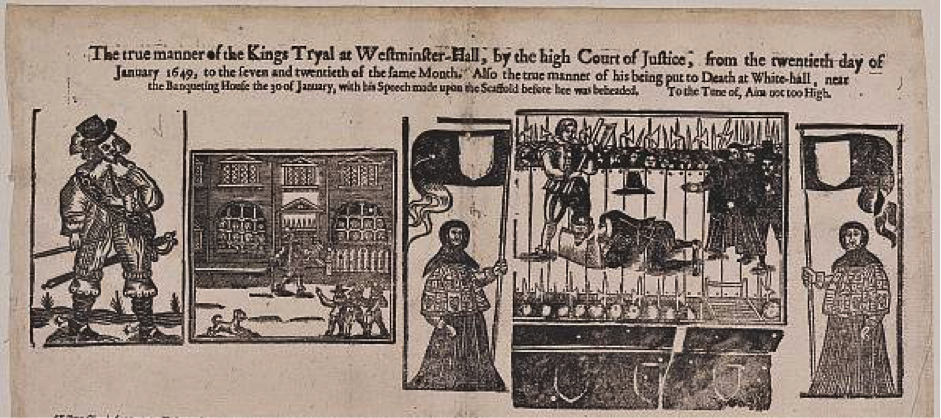
The true manner of the Kings Tryal at Westminster-Hall, by the high Court of Justice (c.1656). Image Courtesy of University of Glasgow Library.
Before 1700, a powerful reason not to criticise the crown was that monarchs had the arbitrary power to imprison any hapless singer or songwriter that offended them. For example, in 1623, James I summarily ordered the imprisonment of singer William Fellowes and songwriter Sir George Calvert, without a trial or any certainty of release, because they performed a song at court that offended him.11Mary Anne Everett Green (ed.), Calendar of State Papers Domestic: James I, 1623–25 (London, 1859), 137–44.
At the same time, printing, selling, or performing a song that ‘alienateth the subiects affection from their soveraigne’ was unquestionably an act of sedition: a potentially capital offence.12Cyndia Susan Clegg, ‘Censorship and the Courts of Star Chamber and High Commission in England to 1640’, Journal of Modern European History 3:1 (2005): 50–80. This was one of the reasons why the Whig campaigner Stephen Colledge was condemned to death for his authorship and extraordinary performance of 'A Ra-ree Show' in 1681.13See Jane Wessel, ‘Performing “A Ra-ree Show”: Political Spectacle and the Treason Trial of Stephen College’, Restoration: Studies in English Literary Culture, 1660–1700, 38:1 (2014): 3–17.
In this case study, I investigate two seventeenth-century songs, produced, published, and performed by songwriters, printers, sellers, and protestors who all believed the political stakes were so great that they were prepared not only to risk publicly criticizing a ruling monarch, but also to envision a future without one.14The third published republican song was ‘The Diggers’ Christmas-Caroll’, while the better-known ‘Diggers’ Song’ – as far as we know – was unpublished. Though unquestionably republican, these songs were written during the republic when—as the song put it—‘William the Conquerors successor was dead’, and his family banished. The history of ‘Digger’ songs reaches right across the period covered by our database and deserves a case study all of its own!
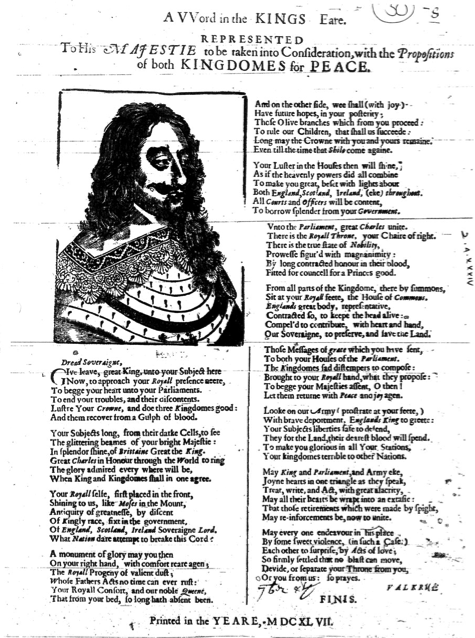
‘Valkrue’ (Henry Walker, attrib.), A VVord in the KINGS Eare. REPRESENTED To His MAJESTIE to be taken into Consideration, with the Propositions of both KINGDOMES for PEACE (1647). Image courtesy of The British Library.
A Word In The King's Ear
The author of our first republican song, entitled 'A VVord in the KINGS Eare', was Henry Walker, a well-known radical preacher and an influential newsbook writer and editor, who unflinchingly supported parliament in its battle against the king’s misgovernment. As his title suggests, Walker believed in taking his complaints straight to the top: indeed, just before the outbreak of the first civil war in 1642, he was arrested and charged with sedition for throwing a libellous sheet directly into the king's carriage.
This could easily have been the end of his life – at the very least he could have lost his ears for such an outrage – but, by then, power over printing was shifting from the draconian hands of the king’s minister, Archbishop Laud, to a less severe parliamentary committee. Walker successfully (if disingenuously) petitioned the crown for mercy, the committee sentenced him to stand in the pillory, and he was immediately ready to publish again.19Joad Raymond, ‘Walker, Henry (fl. 1638–1660), Journalist and Preacher’ (2004), ODNB.
Walker published this ballad broadside in September 1647 in frustration at the stalled peace negotiations.20George Thomason bought a copy and made a note of the purchase date, ‘7ber 8’. Although it is set out like a ballad, no tune is cited, and the verses were perhaps intended to be spoken rather than sung. Charles I’s armies had surrendered in 1646, but the king, held captive in Hampton Court, obdurately refused to negotiate the various peace proposals brought to him by the leaders of the New Model Army and parliament.21For an outline of events, see David Plant, ‘Timelines: 1647’ (2014), BCW Project.
At first sight, 'A VVord in the KINGS Eare' doesn’t look much like a protest song. It opens very much in the ‘epideictic’ tradition, common to early modern political ballads, which lavished praise and affection on monarchs and their families while heaping blame and shame on the heads of traitors and rebels who threatened them or their kingdoms.22See Alan Finlayson’s case study, and David Colclough, ‘Verse Libels and the Epideictic Tradition in Early Stuart England’, Huntington Library Quarterly, 69:1 (2006): 15–30. The song sheet was made fit for a king, being lavishly illustrated with a remarkably fine woodcut royal portrait (based on an engraving after Van Dyke), while many of the verses rehearse exactly the kind of emotionally freighted praise a king would expect to hear.
Yet, the ballad’s respectful approach belies an implicitly threatening message. It makes clear that, after so much suffering, the recovery of the king’s rights, as well as his people’s affection and respect, was entirely conditional upon his accepting the peace proposals put to him by the parliament and the army:
To end your troubles, and [the people’s] discontents.
[to] Lustre Your Crowne, and doe three Kingdomes good:
And them recover from a Gulph of blood …
Vnto the Parliament, great Charles unite.
There is the Royall Throne, your Chaire of right.
There is the true state of Nobility …
King and Parliament, and Army eke
[must] Joine hearts in one triangle as they speak.
Only after making peace with the people’s representatives, would the king be
So firmly settled that no blast can move,
Devide, or separate your Throne from you,
Or you from us
It was Charles I’s failure to understand this fundamental truth, his bad faith in negotiations, and his promotion of a second ill-fated civil war just a few months later, that led not only to him being separated from his throne and people at the scaffold, but also to his dynasty being banished and the launch of a republican experiment across his three former kingdoms.
The Sea-Martyrs
The only other republican song sung to a ruling monarch before 1790 that I’ve come across is 'The Sea-Martyrs'.
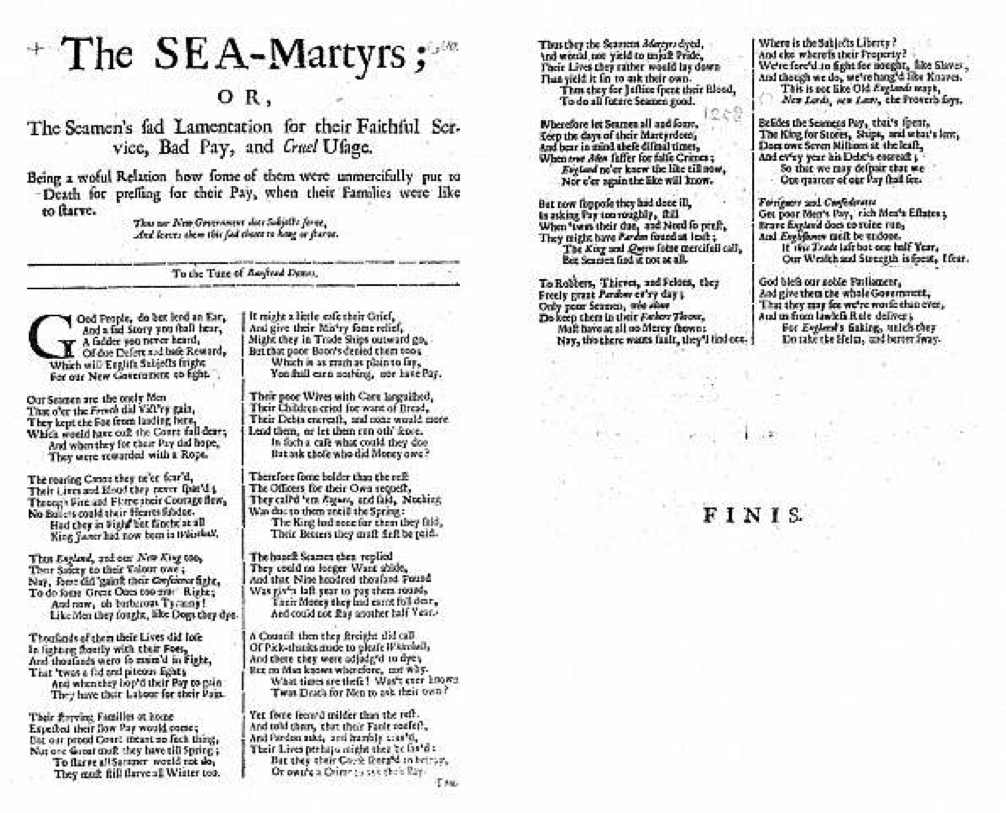
The Sea-Martyrs; OR, The Seamen's sad Lamentation for their Faithful Service, Bad Pay, and Cruel Usage (1692). EBBA (English Broadside Ballad Archive) 22198. Image Courtesy of Pepys Library, Cambridge.
Sailors were renowned as lovers of song, while the ballad was a form through which the trade could publicise their concerns. From at least the early seventeenth century and for centuries that followed, songs of romance, tragedy, and triumph at sea were hugely popular among seafarers and landlubbers alike, whether they were written by professional writers or by sailors themselves. It was a commonplace for songs to underline the landlubbers’ reliance on sailors who bravely faced extraordinary dangers and discomforts to bring goods and security to the country.
It was common too for songs to document triumphant naval battles—indeed songs like these were used as ‘encouragements’ when there were recruitment drives at time of war. Still others, more discouragingly, recounted the horrors of battle, lamented the terrible loss of lives, and expressed the hardships of sailors (and soldiers) who were disbanded, disabled, and forgotten when wars were over.25Angela McShane, ‘Recruiting Citizens for Soldiers in Seventeenth-Century English Ballads’ Journal of Early Modern History, 15 (2011): 105–37. See also James Davey, ‘Singing for the Nation: Balladry, Naval Recruitment and the Language of Patriotism in Eighteenth-Century Britain’, The Mariner's Mirror, 103:1 (2017): 43–66; C. H. Firth, Naval Songs and Ballads, Publications of the Navy Records Society, 33 (London, 1908); Oskar Cox Jensen, Napoleon and British Song, 1797–1822 (Basingstoke, 2015). Yet, whatever their subject, two features were axiomatic: the undaunted bravery of English sailors was praised, and their unswerving loyalty to the crown asserted.26See, for example, 'The maunding souldier' and 'The Muse’s Friendly Aid'; but see also 'The Tender’s Hold'.
The ‘words’ that led to two sailors being hung for mutiny were recorded in this song
'The Sea-Martyrs' appeared after November 1692, soon after the Glorious Revolution that had displaced the Catholic James II from the throne in favour of his Protestant daughter Mary Stuart, and her Dutch husband, William of Orange. In May 1692, a united Anglo-Dutch navy prevented James II from reinvading England by burning a huge proportion of his (French) invasion fleet. Despite this success, however, all was not well with William’s navy. A shortage of ready money meant that thousands of sailors waited at least a year and often longer for their pay. By the 1690s, there were annual winter riots in Chatham Dockyard, as the men were routinely informed their money would be delayed until spring.29Ehrman, The Navy in the War of William III, 132, 233, 449–450. In one case, William met with a ship’s crew to congratulate them and verbally awarded them a cash prize, which had still not been paid some years later. On 12 November 1692, one diarist noted: ‘A councill of war [was held] at Chattham: 5 sentenc'd … to death [including] 2 seamen for mutiny and words.’30Narcissus Luttrell, A Brief Historical Relation of State Affairs from September 1678 to April 1714, 6 vols (London, 1857), vol. 2, 615. Luttrell thought they were condemned to be shot alongside three officers, but diarist Richard Lapthorne recorded that the two sailors were hanged: The Portledge Papers, Being Extracts from the Letters of Richard Lapthorne, Gent, of Hatton Garden, London, to Richard Coffin Esq of Portledge, Bideford, Devon, from December 10th, 1687–August 7th, 1697 (London, 1928), 152. The ‘words’ that led to these two sailors being hung for mutiny were recorded in 'The Sea-Martyrs' song.
At first 'The Sea-Martyrs' draws upon the well-established traditions of sailor’s songs: it highlights the navy’s recent triumph in preventing James II’s invasion, while also recounting the horrific costs to sailors of life and limb:
Our Seamen are the onely Men
That o’er the French did Vict’ry gain,
They kept the Foe from landing here,
Which would have cost the Court full dear …
Had they in Fight but flincht at all
King James had now been in Whitehall …
Thousands of them their Lives did lose
In fighting stoutly with their Foes,
And thousands were so maim’d in Fight,
That ’twas a sad and piteous sight
But this heroic picture of brave and selfless loyalty is immediately contrasted with the unjust and brutal treatment meted out to the two ‘sea-martyrs’. The song re-enacts the arguments put by the sailors to the court martial – dismissed as ‘A Council … / Of Pick-thanks made to please Whitehall’ – which were redolent of the kinds of makeshifts that were common in the merchant navy. For example, the sailors proposed:
It might a little ease their Grief,
And give their Mis’ry some relief,
Might they in Trade Ships outward go
But that ‘poor Boon’ was denied them because, under the terms of the Mutiny Act, joining another ship was treated as desertion. Indeed, two sailors had attempted this just two years before, and had duly been condemned to death for desertion, but Mary II pardoned them on the condition that they returned to their ships.32Luttrell notes on 18 December 1690, ‘some seamen belonging to the Suffolk man of war deserted and condemned’, but, on 7 February, he recorded that ‘The seamen which formerly belonged to the Suffolk and had deserted the same, had been tryed and condemned, but the queen had been pleased since to pardon them; and so they were sent on board again’ (A Brief Historical Relation, vol. 2, 144, 174). Perhaps the pardoned and later hanged sailors were the same; however, no records survive by which this could be established.
The sailors’ case being denied, ‘there they were adjudg’d to dye’, but they were invited to beg forgiveness in hopes of a reprieve:
But they their Cause scorn’d to betray,
Or own’t a Crime to ask their Pay ...
Thus they The Seamens Martyrs died …
Thus they for Justice spent their Blood,
To do all future Seamen good.
Up to this point, the song presents a bitter complaint, and a cohesive narrative, protesting the injustice of ‘due desert and base reward’ that ‘will English Subjects fright / For our New Government to fight’, especially recruits that fought ‘'gainst their Conscience’ for the new government. A typical ballad ran from 10 to 14 verses, and the 14th verse of 'The Sea-Martyrs' sounds like an ending, as it calls upon sailors ‘to Keep [remember] the days of their Martyrdoms’ and looks to a better future. But in the six verses that follow, the tone of the song markedly changes. It moves away from the specific complaints of the sailors to wider political questions.
In verses 15 and 16, both king and queen are expressly criticised for their lack of mercy, given the palpable injustice of failing to pay sailors ‘When twas their due, and Need so prest’. Verse 17 argues that the new regime has changed the customary equitable laws of England:
Where is the Subjects Liberty?
And eke where is their Property? …
This is not like Old Englands ways,
New Lords, new Laws, the Proverb says.
Verses 18 and 19 detail the parlous state of the royal finances, claiming that ‘foreigners and confederates’ are being given ‘poor Men’s pay’ and ‘rich men’s Estates’ to the ruination of England’s wealth and strength. The extraordinary final verse prays for a republican solution, in which parliament will ‘take the Helm’, seize ‘the whole Government’, and deliver ‘us from lawless Rule’.
One Song, Two Writers?
We can never know for sure who wrote this unquestionably seditious ballad, but the discovery of the man who printed it, and the parallels between the song’s last six verses and the printer’s final speech on the scaffold, might just give us a clue. Some, perhaps many, sailors were songwriters, but most much-loved naval songs were written for sailors by well-known or expert songwriters, while others were written in collaboration with people from the music trade. Given its well-informed narrative and its sudden change of political tone, it would be reasonable to surmise that at least two hands were at work on this song, one of whom may have been the ardently Protestant but Jacobite printer William Anderton.38Paul Hopkins, ‘Anderton, William (1663–1693), Printer’ (2004), ODNB. Whigs (like Anderton) who disagreed with the revolution were known as ‘non-jurors’.
In 1695, Robert Stephens, messenger of the press, published an account of the many secret presses and seditious tracts he had unearthed on behalf of the government between 1692 and 1695.39Robert Stephens, An Account of Several Considerable Services that Have Been Done to the Government by Virtue of the Powers Given by the Acts for Printing (London, 1695). This included the discovery, on 2 May 1693, of twenty-four seditious pamphlets in a concealed print workshop operated by William Anderton, which, during his trial, were described as containing ‘the Rankest, Vilest, and most malicious Treasons that ever could be imagined by any man to be put into Paper’.40Trial of William Anderton, 31 May 1693, reference no. t16930531-58, Old Bailey Proceedings Online.
At least two of the libels seized referred to the sailors’ complaints: one was 'The Sea-Martyrs' and the other (now lost) 'A Bob for the Seamen'. Anderton’s immediate reactions on being caught made clear his convictions and helped to seal his fate: he physically attacked Stephens, ‘abused him in a very uncivil manner’, and, damningly, said that ‘he scorned to be a Subject to Hook-Nose [William III]’.41Ibid.
Just weeks later, on 31 May, Anderton was ‘condemned for High-Treason, in Composing, Printing, Publishing and Dispersing, malicious, scandalous, and Trayterous Libels’ and was sentenced to be hung, drawn, and quartered. Meanwhile, to prevent any fuss, the City authorities ordered all ‘the Singers and Sellers of Ballads about the Street of London and Liberties hereof’ to be controlled.42Punishment Summary, 31 May 1693, reference no. s16930531-1, Old Bailey Proceedings Online.
A Last Dying Speech
Just before his execution on 16 June, Anderton requested that his ‘dying speech’ should be put into print.45Anderton’s final speech was printed , along with an excoriating account of the trial, in fellow Jacobite Samuel Grascome’s pamphlet An Appeal of Murther from Certain Unjust Judges (London, 1693), 35–8, which led to further arrests. A digitised edition of the pamphlet is available via EEBO. There are numerous telling parallels in terms of rhetorical style, political sentiment, and some specific phrases, between Anderton’s execution speech and the last six verses of 'The Sea-Martyrs', as can be seen especially in this paragraph:
And now I pray consider where is this Liberty and Property? where the Rights and Privileges of the Subject? Nay, where the very Laws themselves? [(v. 17)] And consequently, where is the Security of any Man? Why, even in the Deliverers Pockets, where your Money is, and where also without all doubt, if you look not well to yourselves, your Estates e're long will be likewise. [(v. 18–19)] I hope you yourselves will put a stop to them, by laying these Proceedings before the Parliament, for had it been Sitting at this present these Proceedings durst not have been practised [(v. 20)]; and I pray God to put so speedy an end to them, that as I am the first, so I may be the last that may suffer by them.46Grascome, An Appeal of Murther, 37. Directing his speech towards the sailors, Anderton also complained that ‘Under the Notion of the necessity of a War … they kidnap our young Men, the Flower of our Kingdom, and directly contrary to Law transport them; and to save their own Foreigners put them in them first Onsets of their Battles … They exhaust all our Stores both for Sea and Land’, and ‘if any Man seem but to disapprove of these their Proceedings under the Notion of Law they murther him’ (35–6).
Destabilising the state by using printed songs to whip up disaffection among volatile groups had been a feature of oppositional politics since the civil wars. For example, London apprentices, who had a culture of rioting, were targeted by radicals in the 1640s and by royalists in 1659–60. Sailors who engaged in annual riots were the ideal target for the Jacobite printers who proliferated in London in the 1690s. However, though Anderton was a Jacobite, the sailors who had just defeated James II’s navy, at great loss of life, were unlikely to call immediately for his restoration, and so in his additions to 'The Sea-Martyrs', he restricted its call to the seizure of power by parliament.
The risks of prosecution were unquestionably great
Songs were an unwelcome but accepted vehicle for petition and complaint in early modern England, though their ability to draw crowds and their potential to change or harden opinion meant that their producers and performers were closely watched by the authorities. The risks of prosecution for those who attacked monarchs, or the monarchy, were unquestionably great. Though many authors, printers, singers, or sellers of protest songs suffered imprisonment or the pillory or faced bankruptcy for directly attacking the monarch in a song in early modern England, it was very rare for them to suffer the full weight of the law, unless – like Stephen Colledge or William Anderton – they were implicated in a wider spectrum of seditious activity.
Nevertheless, republican sentiment was rare in early modern English protest song: criticism was more liberally directed towards ministers, politicians, and the rich and powerful, while (as noted in the case study on hunger songs) monarchs were more likely to be seen as allies than as enemies of the poor. Indeed, even Walker and Anderton, who were seemingly alone in envisioning a republican future in song, were willing to be subjected to a rightful monarch who served the interests of the people.
© The Trustees of the British Museum