
- December 16, 2021
- by Angela McShane
- 12 min. read
The Subversive Voice of Early Modern Hunger, 1596–1774: Songs as ‘weapons of the weak’, or, 'Ballading the ‘badgers’ in times of dearth.
Angela McShane explores the ways in which, for centuries, protest songs were less about roses, and more about bread
It makes my very heart to ake,
To hear poor people thus complaining,
For all their care and pains they take,
Rich men the poor are still disdaining,
But let Rich misers consider well
The poor, and show to them some favour
Or else their Souls will hang in Hell,
All things be dear but poor man’s labour.– Lawrence White, All things be dear but poor Mens [sic] Labour (1675)
A dire shortage of food must surely be one of the most fundamental reasons for people to protest. Historians of sixteenth- and seventeenth-century England tell us:
It is difficult to exaggerate the extent to which people … were conscious of the threat of dearth. Periodic harvest disaster and food shortage were the spectre that haunted early modern Europe.4John D. Walter and Keith Wrightson, ‘Dearth and the social order in early modern England’, Past and Present, 71 (1976): 22–42, at 22.
And yet when ‘the poorer sorte of Her [or His] Majesties subjectes [were] in daunger to famishe’ due to ‘dearth of victuals’, leading to a concomitant inflation of prices, direct actions such as food riots or crowd demonstrations were surprisingly rare: only forty are known to have taken place in the seventy-five years (many of them hungry ones) between 1585 and 1660.5Ibid., 26.
Though the threat of implacable and devastating state-sponsored violence was always a possibility if popular protests went too far, fear of reprisal was not what prevented more riots from taking place. The absence of a regular standing army or civilian police force in England before the nineteenth century meant that power was exercised consensually, bolstered by shared concepts of patriarchal deference on one hand and mutual economic dependencies of plebs and patricians on the other: what the social historian and CND campaigner E.P. Thompson termed a ‘moral economy’ in a seminal study that re-envisaged the frequent food riots of the eighteenth century, describing them as being based on ‘patterns of behaviour for whose origin we must look back several hundreds of years’.6Andy Wood, Riot, Rebellion and Popular Politics in Early Modern England (Basingstoke: Palgrave Macmillan, 2001), 66.
State authorities would first be faced with a ‘mob’ of threatening discourses: open letters, pamphlets, sermons and songs.
When dearth struck, state authorities would first be faced with a ‘mob’ of threatening discourses via a range of performative media. Open letters, pamphlets, sermons, and songs were read or sung aloud before a socially and geographically diverse range of audiences. This cacophony of words and noise not only made clear the desperation of the poor, but also the legal and moral obligations of the rich and powerful. By speaking for and as the people, these carefully calibrated performances safely rallied support among the suffering public, while at the same time forcefully holding those responsible to account.
For example, handwritten letters – sometimes including poems or songs – might be sent directly to local magistrates, grain merchants, rich landlords, or even central government. These texts explicitly threatened violent disorder unless the demands of the poor – whether to enforce the lowering of prices, to bring hoarded food to the markets, or to prevent the export of food from an area by middlemen (known as ‘badgers’) – were met. Sermons conveyed social and moral authority. Drawing on biblical texts and moral examples to persuade the rich to show charity towards the poor, they were perhaps first delivered in a local parish church, and were then printed for a wider audience.9Brodie Waddell, God, Duty and Community in English Economic Life, 1660–1720 (Woodbridge: Boydell & Brewer, 2012); John Walter, ‘“The Pooremans Joy and the Gentlemans Plague”: A Lincolnshire Libel and the Politics of Sedition in Early Modern England’, Past & Present, 203 (2009): 29–67.
Among the battery of discursive media that protested the injustices and inequalities exposed by dearth, songs were one of the most plentiful and powerful ‘weapons of the weak’. A sure sign of their efficacy being that new ones appeared each time a food crisis raised its ugly head. Songs could ventriloquize both the desperate suffering of the poor and the shocking hard-heartedness of the rich. Distributed among, sung to, and sung by ordinary people all over the country, songs protesting hunger drew wide public attention not only to the abject failings of the rich and powerful, but also the certain judgements that awaited them, either after death (as in the verse above) or in life, as happened in a dialogue song between a tenant and his greedy landlord:
Mark what befell to this covetous Moam,
His house it was robbed before he got home,
His chests were broke open, his servants were bound,
He lost in one hour two hundred pound,
This sure was a judgement his neighbours did gu[e]ss,
Because he these words did so often expresse
If Grain hold so cheap as it plainly appears
He should be undone within two or three years
– T.J., A Looking Glass for a Covetous Miser (1675).10T. J., A Looking=glass for a covetous Miser (1675). EBBA (English Broadside Ballad Archive) 33461.
The fear of imminent social disorder that such songs evoked, combined with the powerfully persuasive rhetorical strategies that they employed, was frequently enough to prompt ameliorative action on the part of the authorities before any ‘disorder’ took place. These rhetorical strategies included the emotional and moral power of the voice of poverty; insurmountable biblical support; and a traditional belief that ‘economic and moral assumptions about the market, duty, and greed’ were shared by the highest and lowest in the land.12Wood, 66; see also Waddell; Walter and Wrightson.
While many songs survive that protested hunger across period from 1600 to 1800 – and several feature on our list of 750 – this case study compares and contrasts just three that were produced during periods of severe dearth in 1596, 1675, and 1774. Though each one appeared a century apart from the next, they have some common characteristics.
The songs all emerged from London’s vibrant and dynamic trade in commercial ballads.
In the first place, they all emerged from London’s vibrant and dynamic trade in commercial ballads and benefited from its sophisticated nationwide distribution system. As such, each song was designed to appeal to both a London-centric and a national audience. Secondly, each song was produced in response to a specific crisis and argued that action was needed to alleviate it. The proposed actions were based upon the concept of a moral political economy, which alone, the songs argued, could justify adherence to an inequitable social order. Finally, all three songs successfully combined traditional arguments, well-known tunes, and old images, to articulate the concerns of each new situation.
The three songs also have important differences. The first two were written by well-known authors, who were personally moved to write on behalf of the poor. Regardless of fame, balladeers were rarely well off, and were likely to have experienced some of the hardships that they wrote about. The third anonymously authored song, though well informed, was perhaps differently motivated, being as much concerned to promote promises made by an ambitious politician, as it was to raise awareness of and demand redress for food injustices suffered by London’s poorest. A closer analysis of each song’s context and content reveals more about how these songs reflect changes in food protest over time.
A Complaint of the great Want and Scarcitie of Corn within the Realm
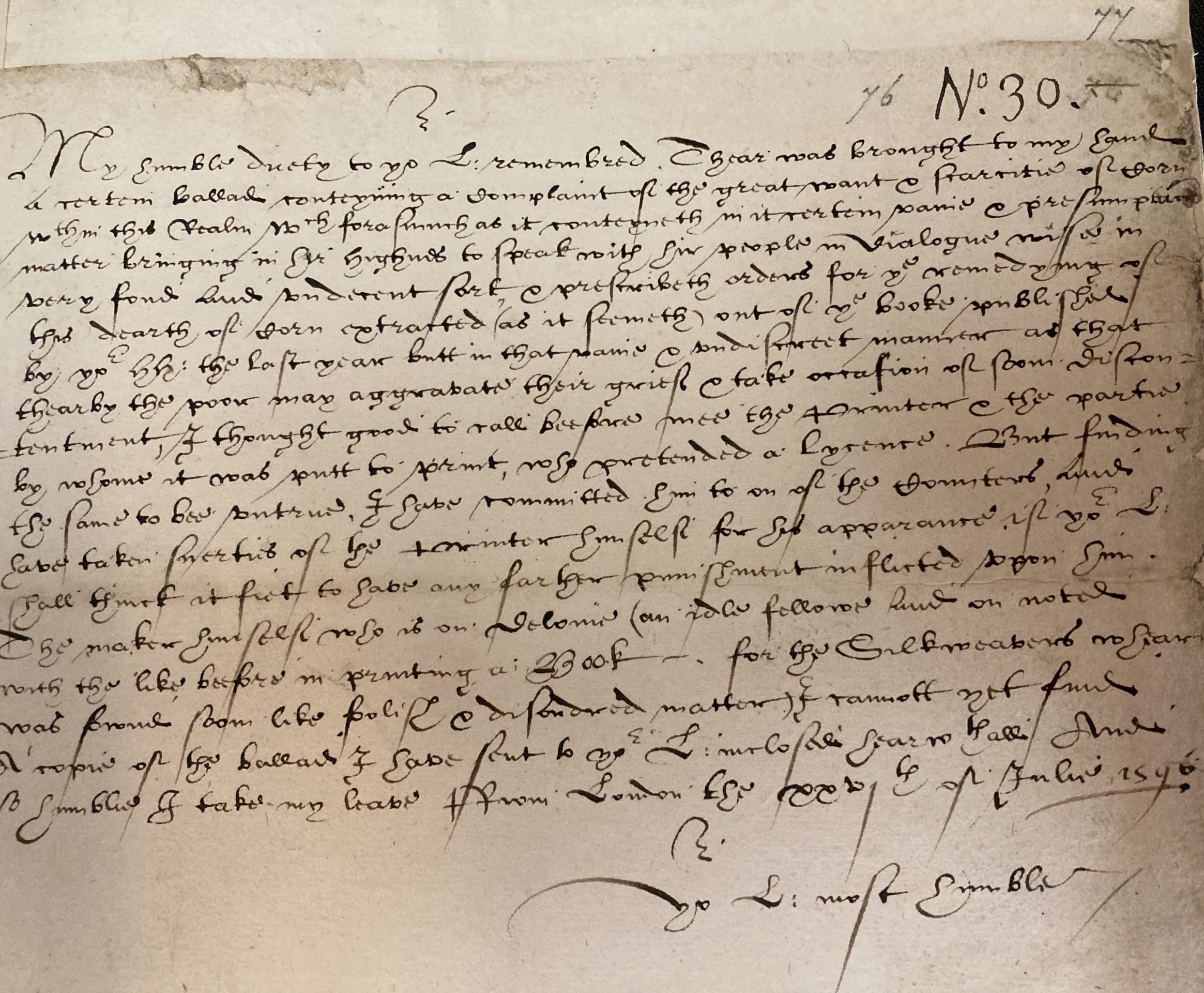
The Lord Mayor of London to Lord Burghley, 26 July 1596, Burghley Papers, BL, Lansdowne MS 81/30, f. 76. It describes 'a certein ballad containing a Complaint of the great Want and Scarcitie of Corn within the Realm'. Image courtesy of the British Library.
A Complaint of the great Want and Scarcitie of Corn within the Realm was authored by renowned playwright and songwriter Thomas Deloney. No copy of the song exists because (as can be seen in the image above) it was suppressed soon after it appeared in 1596, after London’s mayor brought it to the attention of government ministers. However, the mayor’s report tells us some important things about the nature, import, and feared impact of the song:
There was brought to my hand a certain ballad conteyning a complaint of the great want and scarcitie of corn within the realm wich for as much as it conteyneth in it certain [infamous] & presumptious matter, bringing in her highness [i.e. Elizabeth I] to speak with her people in dialogue verse in very fond sort & prescribeth orders for the remedying of this dearth of corn retracted (as it seemeth) out of the booke published by your highness [i.e. Lord Burleigh] last year[,] butt in that [infamous] & indiscreet maner as that thearby the poor may aggravate their grief and take occasion of some discontentment.
Famine and poverty were rife in England in the 1590s, leading to local unrest (including in London in 1595) and a widespread increase in vagrancy and petty theft. The need to combat the worst effects of the shortages, combined with pressure from landowners and citizens who feared that more vagrants would lead to greater crimes against their properties, forced the government to act. Firstly, in cases of dearth the government relied upon the publication of ‘Books of Orders’ which, when issued, gave local magistrates both the power and the responsibility to control local prices and ensure fair food distribution in their area. Secondly, they improved and strengthened the system of parish poor relief that was paid for by a rate on local property owners, and which provided relief for the ‘deserving’ poor and severely punished those who were deemed idle vagrants.
In 1596, Deloney’s song ventriloquized the voice of the queen on behalf of the poor, and specifically called upon the queen’s ministers to reissue Books of Orders and force local magistrates to control food distribution and prices. Though all the copies of his protest song were seized, the printer was imprisoned, and the publisher lost his money, the song did achieve what it could for the hundreds of people in town and country who were suffering from famine. It was read by the very authorities who needed to see it, and action was taken: the government did instruct local magistrates to obey the Books of Orders they had already issued and ensure the provision of food in areas of dearth at prices that were accessible to the poor.
As stomachs griped, songwriters focused their attention on the covetousness of the rich.
Deloney’s song is also important for the history of protest song. It was one of a long line of English songs that demanded government action to resolve a national famine caused by harvest failure. In the next century the threat of widespread famine receded, especially after the 1620s, but weather conditions and bad harvests could still cause sudden rises in price – often at the same time as trade slumps that depressed wages. The 1630s and 1640s both saw shortages and price rises that caused severe distress, but as hunger raised its ugly head once more, thanks to new Books of Orders that were issued in the name of the king, central government was seen as an ally rather than a culprit. Instead, as stomachs griped, songwriters increasingly focused their attention on the covetousness of the rich as a causal factor and demanded that local elites should fulfil their moral and economic responsibilities towards the poor on their estates and in their local parishes.
All things be dear but poor Mens Labour; Or, The sad Complaint of Poor People
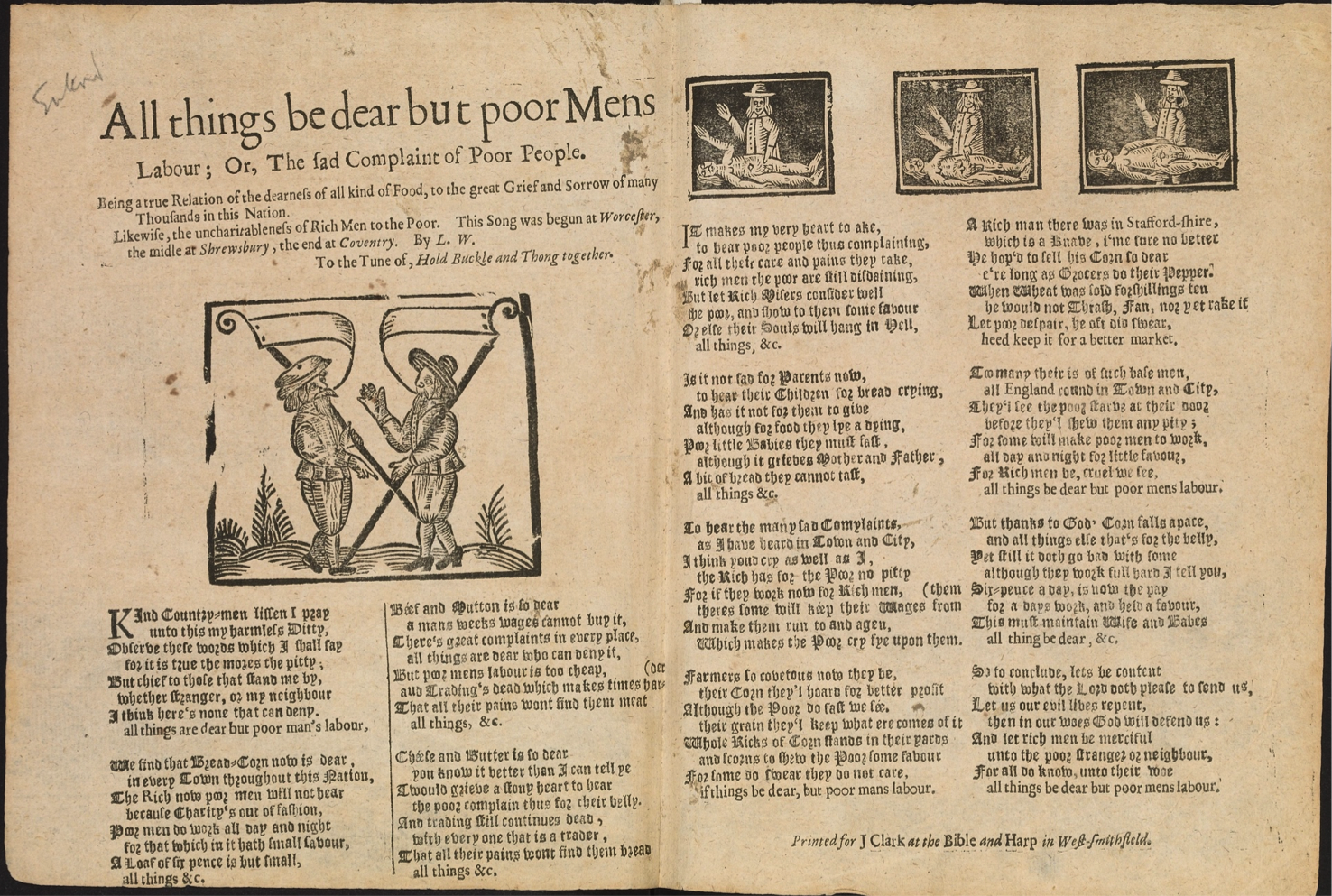
Lawrence White, All things be dear but poor Mens Labour; Or, the sad Complaint of Poor People (1675). ‘To the Tune of, Hold Buckle and Thong together.’ Bodleian Ballads Online, Wood E 25(119). Roud no.V8906. Image courtesy of the Bodleian Library.
It was in the latter context that All things be dear but poor Mens Labour; Or, The sad Complaint of Poor People was published in around 1674–5. It was authored by Lawrence White, who was known for writing moralising songs and pamphlets that protested injustice and greed and gave examples of the judgements that had beset those who ignored God’s commandments and precepts.
From 1674 until 1676, poor harvests and high food prices caused widespread suffering across several counties of England. As one sermonising pamphlet put it:
It cannot but be known to all (by sad experience I fear too many of the poorer sort) that most kinds of Provision have of late been dear, and particularly bread … partly by reason of the thin harvest … and partly too from the wretched Covetousness of some Farmers, who kept up their Corn on purpose to make a Dearth.17Anon. Gods great and wonderful work in Somerset-shire, or, The charitable farmer miraculously rewarded (London, 1674), 4.
This pamphlet was just one part of a ‘riot’ of performative discourses, including at least one more pamphlet and four songs, published in 1674 and 1675 that ‘[Set] forth the Miserable and distressed Condition of many Hundreds of the Poorer sort of People who are almost ready to starve in these Hard Times, when Fireing, and all sorts of Provisions are so dear’.18Lawrence White, The Poor Folks Complaint. EBBA 22003.
Together, these discourses – four of them by White himself – pulled together all the rhetorical strategies and implied threats discussed above.
White took centre stage in this protest of near operatic proportions. While the sermon-like pamphlet, published in 1674, had declared itself to be unlike ‘those many stragling sheets, wherewith our Streets are daily pestered’, White soon subverted that position by shamelessly adapting it, word for word, into a spoken text that could be read out loud to passers-by.19Anon., Gods great and wonderful work in Somerset-shire, 4. His speech included many more details about the hardships people had encountered, and risings that had taken place, including one where
a hundred of men, old and young in arms, and cut those Bagers [badgers’] sacks, and took their corn, and filled their pockets with it, and said their wives and children was ready to starve,
but it also told the tale of how a ‘charitable farmer’, who brought his corn immediately to market and sold it at a fair low price, had been divinely rewarded with a miraculous crop of wheat.
To this speech, White added three related ballads, and soon he took to the road to protest with speech, songs, and images. Two of his songs were set to the same (now unknown) tune, appropriately called ‘Hold Buckle and Thong Together’, but they addressed very different audiences. All things be dear was directed at ‘Country men’, who, it acknowledged, well knew the dire effect of the shortages. Sympathising with the agonies of hunger, and laying the blame squarely on covetous rich landlords, employers, and farmers, who held their corn back, the song ended with some hope that prices were beginning to be better, though men still needed fairer pay to be able to afford them. The Poor Folks Complaint was directed at ‘You Rich men that do live at ease / And Misers that do hoard up treasure’ and emphasised the dire need of the deserving poor. God’s great and wonderful work retold the tale of the ‘charitable farmer’, drawing the attention of his listeners to the images of the miraculous wheat, but it ended by castigating the thoughtlessly rich and greedy, reminding them that ‘King and Beggar both are lumps of clay’.20Lawrence White, God’s great and wonderful work (1676). Bodleian Ballads Online, Wood 276b (101).
A new touch of the times or Success to True-Blew
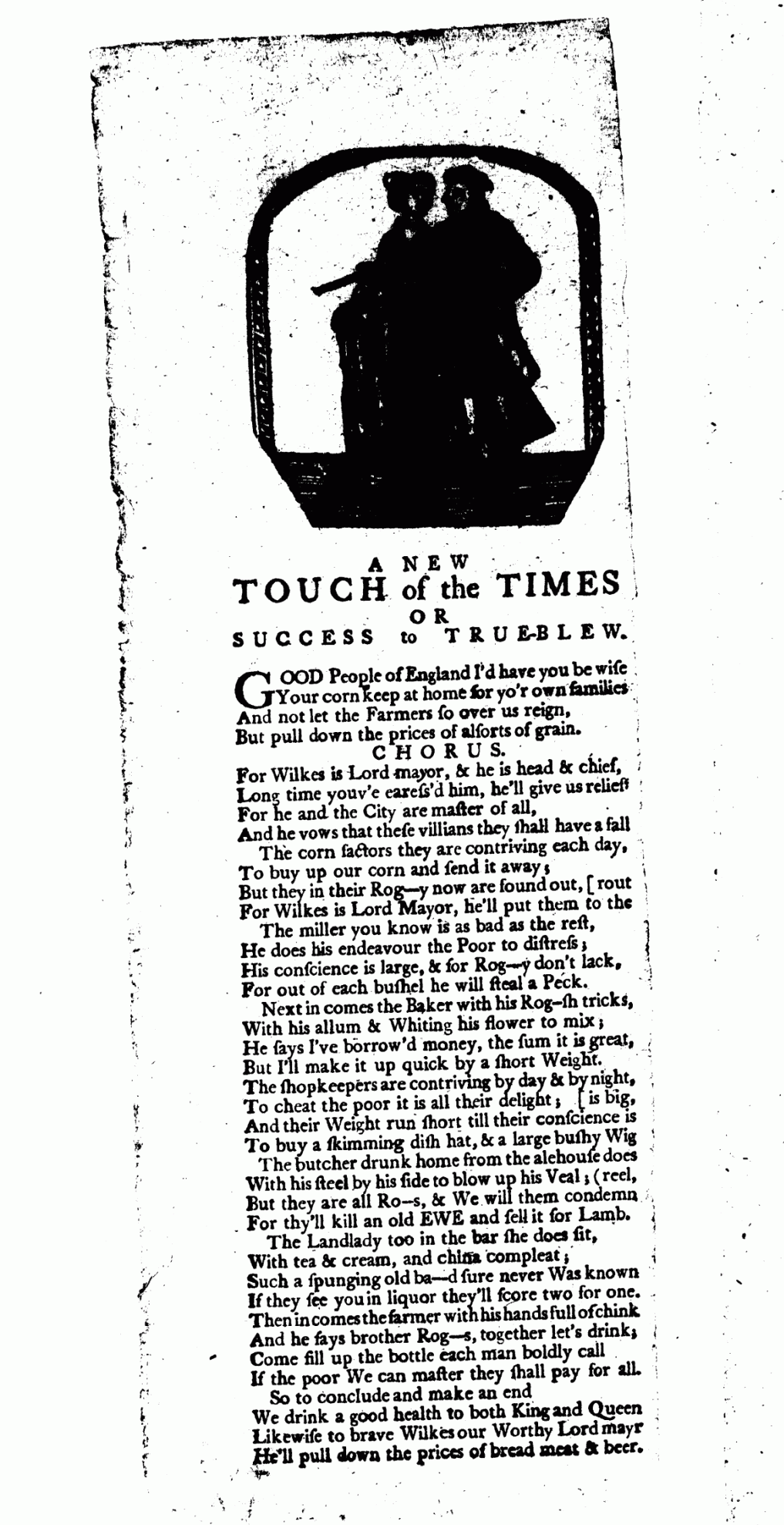
A new touch of the times or Success to Trew-Blue (c. 1774-5). Bodleian Ballads Online, Firth b.22(f. 107/1). Roud no. V25840. Image courtesy of the Bodleian Library. Select it to view the whole song.
By the time that our third song A new touch of the times or Success to True-Blew was published in 1774–5, much had changed in the song trade. In the most popular market, the luxuriant broadsheets of the seventeenth century were replaced with the short slip songs of the eighteenth. In many ways, the production of these songs reflected concerns about quality and value for money in the food markets. Set to an old political tune, ‘Touch of the Times’, the song was addressed to the ‘Good People of England’. In fact, it protested exploitative trading practices and the poor quality and high prices of bread, meat, and beer in London. The balladeer promised listeners that the political radical John Wilkes, recently elected as Lord Mayor, would ‘give us relief’ by addressing all the injustices laid out in the song, as a reward for the poor who had ‘long since … caressed him’ (by supporting his political campaigns).
On the one hand, the song had a familiar refrain to go with its old tune: poor harvests could still bring excessively high prices to urban food markets, leaving them at risk of dearth if it was exported from the city to sell elsewhere, or if it was held from the market to force prices up, and the authorities were deemed responsible for finding a way to alleviate hunger. On the other hand, the song expressed new concerns, that manufacturers and processors of urban food were raising prices at the same time as reducing its quality, while no moral arguments are brought against these malpractices; rather, the answer was to be found in the political sphere, via the ballot box.
Conclusion
Just as food riots were part of a carefully scripted response to dangerous times, balladeers too followed a ‘script’, by using a variety of persuasive strategies. In the earlier period, when central government felt threatened, a balladeer’s strategies might also include strategies to avoid prosecution, by claiming that they were singing an old song, or that their song only told of a dream, or by hiding specific criticisms as a moral complaint. But from the 1630s, central governments were seen as allies, food protests targeted local culprits, and there was more freedom in what could be said.
The three songs discussed above reflect these broad shifts, but also demonstrate changes in the instrumentality of protest songs. Deloney’s banned song demanded that central government should act over dire national food shortages caused by harvest failure and proclaimed the need for equitable distribution and low prices. White’s songs also protested at unsustainable rises in urban and rural food prices, but he pointed at the disastrous impact on the poor of the covetousness of corn hoarders, who deliberately created shortages to raise prices. The last song complained of a range of food-producing villains who were daily encountered by London’s urban poor: ‘corn factors’ who exported local grain, forcing local prices up; millers who stole from the sacks sent for grinding; bakers who produced adulterated bread; and false-dealing shopkeepers, butchers, and cookhouse landladies – but this song argued that an elected civic authority was their best hope for relief.
While the desperate cries of hunger that prompted them were only too real, these songs were able to represent and mobilise the rhetorical and emotional power of poor voices, ensuring that they were heard, believed, and acted upon by the necessary authorities. Moreover, by transposing the discourse of protest from food riots to the ostensibly harmonious but shaming medium of song, they further protected the distressed poor from the danger of violent sanctions.
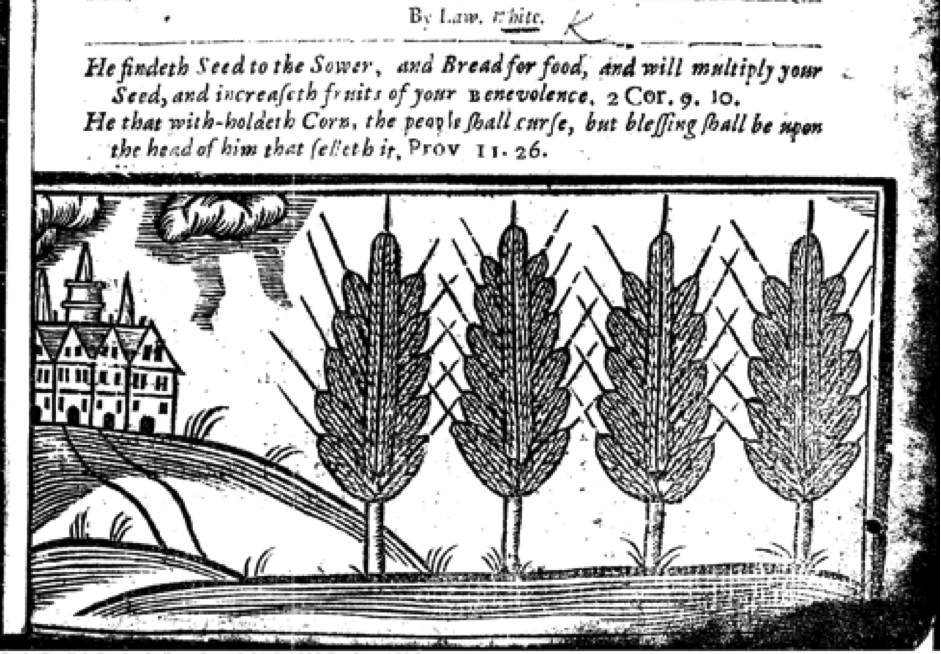
Frontispiece from Lawrence White, The charitable farmer of Somersetshire: or, God's great and vvonderful vvork (1675). The image depicts God’s miraculous reward to the charitable farmer of an ‘extraordinary cr[o]p of wheat, like never before heard of, each stolk [sic] of straw, having divers full large ears … on every straw throughout the field, which was ten acres and upwards’. The local market town is shown in the background. Image courtesy of the British Library.