
- November 8, 2021
- by Oskar Cox Jensen
- 15 min. read
The Same Old Tune: Types of contrafactum in English protest songs
A look at how songwriters have used existing tunes to bear their new lyrics over the centuries
In recent years, many scholars interested in the politics of song in the past have focused on the idea of contrafacta, a term borrowed from medievalists. A contrafactum (singular) is defined in Grove Music Online as ‘the substitution of one text for another without substantial change to the music . . . most commonly applied to the practice of composing new poems to older melodies’. In other words: putting new words to an old tune.
The political possibilities of this practice are immediately apparent: tunes often come freighted with associations – think, most obviously, of a national anthem – and a new political message set to such a tune can double-down on those associations, appropriate them, ironise them – so long as the listener shares the existing cultural knowledge that brings those associations into being.
But we need to be careful in leaping to conclusions about contrafacta in the long history of protest song. Though contrafacta are still common in the twenty-first century west, in settings such as the school playground, the church, the football terrace, and even the political arena (‘Oh, Je-re-my Cor-byn’), they play little part in the commercial, recorded music that forms much of our daily soundscape. Our tendency is to think in terms of parody: the US singer ‘Weird Al’ Jankovic is often cited as the leading example of the practice; UK readers of a certain stamp are likelier to think of the Radio 4 show I’m Sorry I Haven’t A Clue, and its game ‘one song to the tune of another’ – in both cases, the juxtaposition of old tune and new lyric is central to the purpose and generative of new effects, usually comical.
Though contrafacta are still common in the twenty-first century west, they play little part in the commercial, recorded music that forms much of our daily soundscape.
Streaming is changing this parodic predominance. Jon Stratton has written recently of the explosion in coronavirus-theme contrafacta that these songs ‘are not parodies’, but simply take advantage of well-known tunes: the musical setting is not itself central to the new song’s meaning, but rather a more-or-less neutral device to facilitate the dissemination of new, original lyrics.
This takes us closer to the era before cheap recordings, meaning in our case England from roughly 1600 to 1920. In these centuries contrafactum, far from being a conspicuous and rare form of songwriting, was more often the default mode of composition for ‘mainstream’ songs. Whereas the art songs of high culture were usually created by a composer setting pre-existing poetry to music, the songs in general circulation were most often created by a lyricist setting new words to a familiar tune. Politically-loaded contrafacta have been written in both periods. But in the earlier, longer period, these existed within a wider culture that employed the same method; in the later, shorter period, such songs draw attention to themselves by diverging from a commercial norm of original musical composition.
There is one simple conclusion to be drawn from this: for most of the period we are covering, we cannot assume that a political writer’s choice of melody was a choice made for political reasons, nor that an audience (itself usually far from uniform in its knowledge and preconceptions) would have recognised it as such. In order to understand how people have played politics with their melodic choices, we need to fine-tune our ears.
Types
In all periods, there have been two broad ways in which naming a pre-existing tune to your new song can bear a political message. One way is on the page itself: the simple act of naming is an eloquent rhetorical device. Until relatively recently, songs were incarnate in texts, not recordings, and the lyric on the page – of a broadside ballad, a slip-song, a pamphlet, a songbook, a website, even a notated score – specifies a tune, if at all, right at the top, following the title. The reader and potential singer is thus immediately faced with, in effect, two parallel titles placed in dialogue. If the juxtaposition is a potent one, there is no need to sing the song or even read the full lyric to appreciate the point being made.
This practice was especially prevalent in the seventeenth century, when the intended tune was named more often than in later years. The point could even be condensed to a single new title that itself cannibalised the tune, such as ‘God Save Great Thomas Paine’ or ‘God Save the Rights of Man’ in the 1790s, the radical effrontery of which are immediately apparent. The rhetoric of naming even became idiomatic in the phrase ‘a new song to an old tune’ – a quip on the lips of political cynics throughout the ages.
This technique, which effectively takes place without a note being uttered, is discussed in more detail in a separate case study. Here, we will focus on the politics of contrafacta when the musical dimension itself is considered. Broadly speaking, it is possible to posit six types of political contrafactum – though were these types to be used in a Venn diagram of actual songs, the result would be a kaleidoscope of overlapping sections.
Type One: Political choice (straight)
This is the most straightforward of all choices: a songwriter reinforces their message, or makes their political point, by setting their words to a tune, the existing associations of which align with their own intentions. When the new words are sung, recognition of the tune either strengthens their force or helps frame their meaning. In the realm of political protest, this might involve an English Jacobin in the 1790s setting new words to the ‘Marseillaise’, or opponents of renewing Britain’s nuclear submarines singing their argument to the tune of ‘Give Peace A Chance’.
For almost two hundred years, a particularly effective and interesting tune choice here was ‘The Vicar of Bray’, written around 1714 and itself a variation of a much older series of songs. ‘The Vicar of Bray’ has a distinctive tune in two parts, the latter of which may also be used as a chorus. The song concerns a turn-coat clergyman who cuts his cloth, or alters his opinions, according to the prevailing wind: an unprincipled toer of the establishment line who expresses the views of whoever is in power at the time. This archetype is a useful one for political protest, and the song was frequently re-worded to accuse specific, topical individuals, parties, or causes of similar hypocrisy. Our 250 contains the song ‘Medical Orthodoxy’, an anti-vaccination protest from 1879 that uses the tune to accuse doctors of constantly contradicting their own advice in order to exploit the populace and line their own pockets.
Type Two: Political choice (contestatory)
This type is the former’s natural corollary: a tune with an established set of political associations is used by opponents of that position, in order either to reappropriate the cultural capital of the song, or as an act of subversion. This technique requires a kind of double-think, as it relies upon the tune having a commonly-understood and fixed ‘meaning’, whilst actively working against that meaning.
This practice was at its height in the long eighteenth century, the age of ‘national’ songs, and the ultimate archetype is indeed the song that became the national anthem, ‘God Save the King/Queen’. Our 750 abounds with instances of radicals and republicans making use of this loyalist, royalist tune, either in a bid to portray their own cause as patriotic, or to undermine the monarch and set up the people in its place. But the version of ‘God Save the King’ that became popular in the 1740s is itself almost certainly a contrafactum: as Alison Morgan and others have documented, the song appears to have originated decades earlier as a Jacobite drinking song, sung by opponents of the reigning monarch in support of the Stuart pretender who, the song claimed, was ‘soon to reign over us’. Sometimes, a contrafactum is so effective that it entirely obliterates a song’s former associations.
Type Three: Political choice (parodic/irreverent)
This is a variant of the previous type: rather than contesting an existing song’s associations by taking it seriously, a songwriter aims for comic effect, employing a tune that will add political irony or bathos to their message. While the intent may be to make the existing song ridiculous, it is perhaps as common to take a tune regarded as light or flippant, rather than itself political, and use these associations to lampoon the subject of the new lyrics – for example, employing a nursery rhyme to attack an important politician.
One especially subtle example is the 1911 ‘Idris Strike Song’, sung by striking female factory operatives to the tune of 1908’s ‘All the Nice Girls Love A Sailor’. On one level, the music-hall, sea-side associations portray the unionised women as high-spirited and in good morale, whilst simultaneously attaching a faintly comical association to the bosses and politicians addressed in the song. On another level, its general irreverence may be heard as a feminist act of reclamation, in making use of a song that objectifies and patronises women in order to advance a message of female solidarity and emancipation.
Type Four: Metrical choice
In the previous three instances, while the tunes chosen serve multiple musical purposes, the choice itself is primarily driven by a set of extra-musical political associations. In these three, the priority is reversed. A metrical choice for a political message is less about summoning to mind a title or an idea, than utilising a tune that will help a writer’s new words come across well to an audience. Political messages are notoriously difficult to communicate in sung lyrics if they are more complex than a one-line slogan. The fleeting, sequential, ephemeral nature of singing and listening makes it hard for an audience to retain an extended argument in their heads whilst listening to its continuation. In England, political vocabulary often involves words of an unusually high syllable count, derived from Latin or Greek in such a way that they are hard to rhyme except with words of a similar nature, ending in -ation, -ism, -cratic, and so on. In short: beyond the level of the pithy slogan, politics is hard to sing. An astute contrafactual choice can help, however, if a writer chooses a melody that lends itself to the communication of extended argument.
A melody, especially in the conventional forms of eight, sixteen, or twenty-four bars, usually with an AABA structure, that dominated song composition for centuries, has its own rhetorical gestures that can support a text. A four-line verse might reach a high point at the end of line three, poised upon the dominant: musically, this asks a question that is answered in the fourth line, in a cadence that might resolve emphatically upon the keynote. Melodic gestures can emphasise certain words in a line or lend themselves to repetititon; they create a consistent oratorical platform for performance that can do a lot to get a message across. Above all, a good chorus melody goes a long way towards encouraging the memorisation and further spread of a message.
The 1783–5 song ‘Sit Down Neighbours All Bow Wow Wow’ is exemplary of all of this. Its verse is practically recitative – lines one, two, and four open as measured speech – thereby maximising comprehensibility, yet all four lines end on a distinctive, lingering, falling cadence, giving these end-words, which also bear the rhyme, a marked and memorable rhetorical emphasis. The ‘speech’ with which the first line begins is all on the key-note; the second line repeats the trick a tone up, on the second or supertonic, a slight increase in pitch that might easily suggest a move forward, an advancing of the argument. A still-higher range for the third line, as if in a raising of expectations, is concluded by a much lower fourth line that descends to the same low fifth or dominant note with which it all began, a growl of resolution that nonetheless primes the western ear for the chorus. And what a chorus – short, pithy, emphatic, and both incredibly easy and great fun for an audience to join in with. In the original setting, it is pure nonsense: ‘Bow wow wow, fal lal di iddy iddy, bow wow wow’. Contrafacta often replace these lines with more meaningful words, but the performative potential is the real point: a short, satisfying, collective release of tension. No wonder so many of the dozens of contrafacta to this tune, some of which are available on the Bodleian’s site, were political: it is the perfect choice for political communication, the chorus hooking and engaging the audience, the verses helping the argument get across.
Type Five: Pragmatic choice (functionality)
Our three ‘pragmatic’ choices are not easy to differentiate: the distinction between them is one of emphasis. The focus here, so far as a writer’s intentions are concerned, is upon the practical function the new song is designed to fulfil. If you have a satirical lyric in mind, perhaps choose a tune popularised by a stage comedian; if your protest is a pious one, to be sung by a collective used to worshipping together, why not opt for a psalm or hymn? If it is a song to march to, to boost morale and coordinate the tramp of purposeful feet, then it’s probably best to use an existing march, with a 2/4 time signature, a major key, a tune that has stirred hearts before and that can be accompanied by mobile musicians with wind, brass, or percussion instruments. It is all about employing the tried and tested, the right tool for the job.
In the early twentieth century, the suffragettes could boast renowned composers – Alicia Needham, Ethel Smyth – yet continued to set many of their songs to existing tunes. A favourite was the Welsh march and anthem ‘Men of Harlech’, used for two songs in our 250 from 1910, the anonymous ‘Rouse, Ye Women’ and Theodora Mills’ ‘Shoulder to Shoulder’. Much used at the time as a regimental anthem, ‘Men of Harlech’ ticked all the boxes for a militant, organised demonstration.
Type Six: Pragmatic choice (accessibility)
The final ‘type’ is the simplest of all, though necessarily entangled with previous choices: in order to encourage a new lyric’s performance, memorisation, positive reception, and further dissemination, a writer uses a tune that is widely-known and popular. This was naturally of greatest importance in the period before both recording and mass literacy, when familiarity with a melody could be crucial in the spread of new words by oral transmission. A tune that is known to and pleases both listener and hearer is as good a recommendation as any for the message that it carries.
The ultimate exemplar of this is the early modern tune known variously as ‘King John and Lord Abbot’ or ‘King John and the Abbot of Canterbury’, or in later centuries both ‘A Cobler There Was’ and simply as ‘Derry Down’ – the latter being the words of its conventional refrain. Vastly popular in the seventeenth century, the tune was enshrined in the nearest thing song came to a canon by its inclusion in John Gay’s 1728 smash hit The Beggar’s Opera, and continued to rank among the best known – and most frequently repurposed – of English tunes until late into the nineteenth century. The tune itself was naturally subject to some variation over these centuries, but consistently retained its meter, AABB rhyme scheme, the shape of its refrain, and all the important anchoring notes of its melody: above all, the distinctive leap to the high fifth or dominant note at the end of the third line, on which a singer might hover deliciously before the precipitate downwards rush of the fourth line, itself running headlong into the refrain. A swaggering old warhorse of a tune, its evergreen status sees it heavily over-represented on our list.
Conclusion
The political stakes of contrafactual songwriting can vary considerably. In some cases, the tune is itself the important thing – the new song seeks to take ownership of an anthem; the protest hinges on undermining a political target by associating them with a particular melody. In others, the tune is an instrument, a vehicle, contributing only to the efficacy and not to the meaning. The multiplicity of possible factors in play makes the whole question much more interesting than the simple equation that use of tune X thereby invokes political association Y – a formulation that removes the role of music altogether and relies in the first place on the audience recognising the association, since the music as music contains no semantic meaning.
Similarly, it would be a mistake to insist upon the six types listed above as discrete from each other: most actual instances involve several types working together, even co-creating each other. ‘Derry Down’ fulfils the requirements of type six only because it has already fulfilled the requirements of type four. Imagine: a tune is commonly used (6) for a specific genre of song because it is fit for the purpose (5), due in part to the platform its music affords the lyrics (4); and because of this it is often used by faction X for a consistent political purpose (1); so much so indeed that it has become emblematic, leading to rival faction Y also using it, in an attempt to capitalise upon its potency (2); finally, faction Z, disgusted of all this cosy back and forth, seeks to strip the credibility from both X and Y’s performances by popularising a risible new contrafactum of the same tune (3).
Perhaps it is simplest to conclude that the most important factor in choosing a tune is always, does the tune fit the purpose? (This is almost, but not quite, to ask, is the tune any good? – a subjective question that fails to account both for individual preference, and for the context of performance.) If the tune works, it is likelier to endure and to have an impact – and so is your contrafactum.
The complexities of contrafacta might best be encapsulated in the socialist protest song ‘The Red Flag’, penned by Jim Connell in 1889 – itself the second ‘Red Flag’ in our 250. Connell’s wish was that his lyrics be sung to the tune of Robert Burns’ ‘The White Cockade’ – one of two influential but completely separate eighteenth-century tunes of that name, a name bearing its own associations of Jacobitism that had lost their loadedness by Connell’s time. The tune, however, endured for good reasons: it could be performed as either up- or downbeat, as merry march or moving ballad; it was embedded in everyday culture; and it was forever linked to the foremost poet of the labouring poor. But Connell’s wish was not realised: the twentieth century sung ‘The Red Flag’ to the tune of ‘O Tannenbaum’, written or at least arranged by the Renaissance composer Melchior Franck, and popularised as a carol in England in the Victorian period. Though politically neutral, this tune proved admirably fit for purpose, and before long, the nascent Labour Party adopted the new song as its official anthem. In the 1950s and ’60s, ‘The Red Flag’ was itself the subject of numerous parodies – such as those in which the flag is ‘palest pink’, or ‘The Foreman’s Job’, a cynical story of a promoted worker abandoning his principles – in an effort to undermine the socialist cause via its anthem. Yet ‘O Tannenbaum’ kept its separate identity as a Christmas carol, and Stephen Fry tells the story of a public schoolboy being reprimanded by an irate Tory schoolmaster, c.1970, for humming the tune in all innocence, unaware of its radical associations.
This kind of non-verbal rendition, whilst not itself a contrafactum, remains the most eloquent proof of the technique’s potential: if a political point can be made purely by the performance of a sequence of musical notes – which, we must remember, contain no inherent meaning – then the tune in question is a potent one indeed. Such was the case on the original Bloody Sunday of 1887, when protesters marching through London signalled their defiance in the face of police violence by whistling the tune of the ‘Marseillaise’. All that could be heard was a succession of high-pitched notes, in timbre more like the voices of birds than those of humans. But – in yet another irony of the associations summoned by a name – they summoned the spirits of revolution and resistance to Trafalgar Square itself.
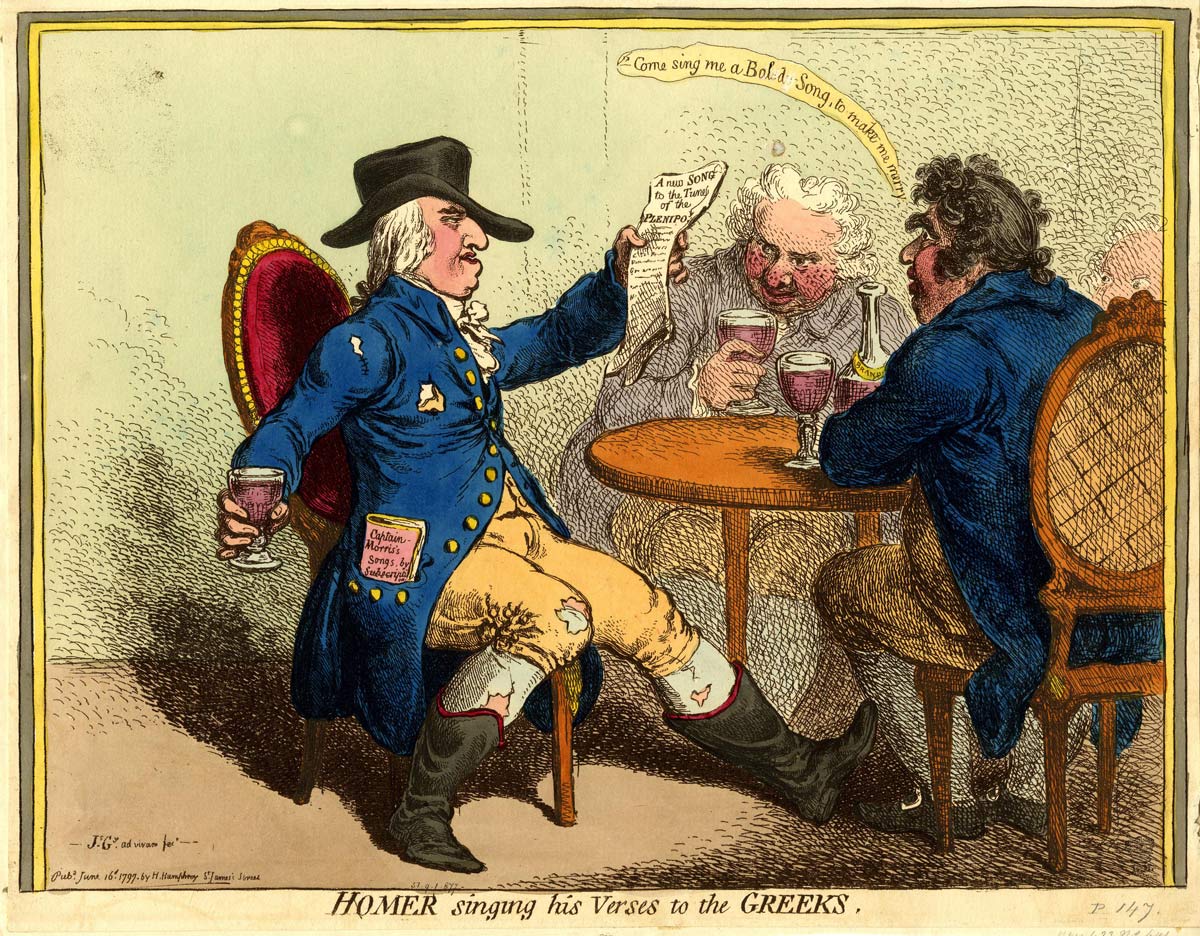
Captain Charles Morris sings one of his own contrafacta. © The Trustees of the British Museum.