
- April 28, 2022
- by John Street
- 6 min. read
‘Strike!’: The Story of a Protest Song
The remarkable inside story of one subversive song, featuring the guest vocals of one Margaret Thatcher...
‘Strike’ by The Enemy Within was one of many musical interventions in the miners’ strike of 1984–5. It was unusual, though. It wasn’t Billy Bragg’s ‘Between the Wars’, or Style Council’s ‘Soul Deep’, or Latin Quarter’s ‘The Men Below’. ‘Strike’ owed more to hip hop. For its vocals, it sampled the voices of Arthur Scargill, the President of the National Union of Mineworkers (NUM), and of the miners themselves: ‘Strike. This battle, this battle, this battle is not yet at an end...’, it begins. And it finishes with Scargill’s voice saying:
There are four and half million people who want to go to work, four and a half million, four and a half million, four and a half million, four and a half million, Stand together…
In the New Musical Express, Richard Cook described the sound of the track:
There is no wrinkle of melody here, almost no constant rhythm; just a constant cross-batting of thuds and cracks and booms, flashes in the dark.
The accompanying video features no performers, just miners at work and on strike. The single was released in a plain black sleeve with a sticker in the top corner, replicating that used by the NUM, which contained the words ‘Support The Miners. The Enemy Within.’
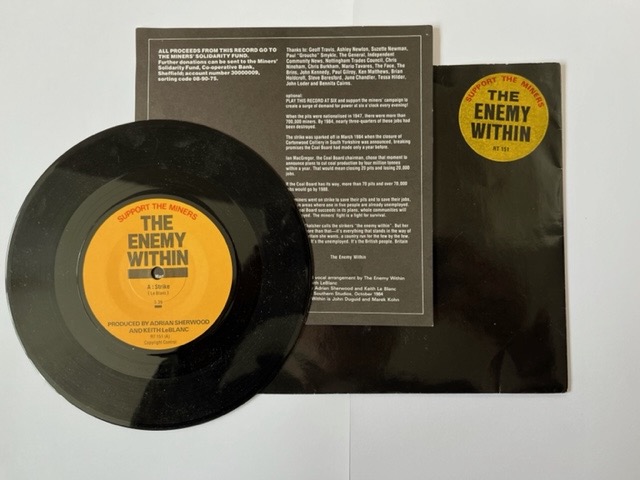
The 7" version of the single and its insert
But it wasn’t just its sound and visuals that made ‘Strike!’ unusual. Its origins too set it apart from standard music industry or protest song narratives. It began, it seems, as an office joke at The Face, a magazine that straddled music, fashion and politics, in very distinctive style (thanks to its designer, Neville Brody). In the strange alliances that were formed in the heat of the strike, Labour Party branches twinned with striking miners to organise benefit events. One of these was held at Soho’s Wag Club, typically the haunt of the most fashionable youth stylists, themselves regular fare for The Face.
But it wasn’t just its sound and visuals that made ‘Strike!’ unusual. Its origins too set it apart from standard music industry or protest song narratives.
These surprising bedfellows prompted the joke. Reflecting on Scargill’s reluctance to hold a vote on the strike action, it occurred to Marek Kohn, a contributor to The Face, that Scargill could release a record, parodying the recently released Malcolm X’s ‘No Sell Out’ track, in which Scargill sung ‘No Ballot’.
The joke became a reality, thanks to the initiative taken by Kohn and his friend, John Duguid, who was then working for NALGO. The pair came up with the idea of making a record that featured Scargill, albeit not as a singer, but as an orator, and that could help raise funds for the striking miners. They set about recording and transcribing speeches by Arthur Scargill, as well as taping interviews with rank-and-file miners and their families.
These recordings were to be become the vocal track, carefully arranged by Duguid and Kohn, and extracted from some six hours of tape.
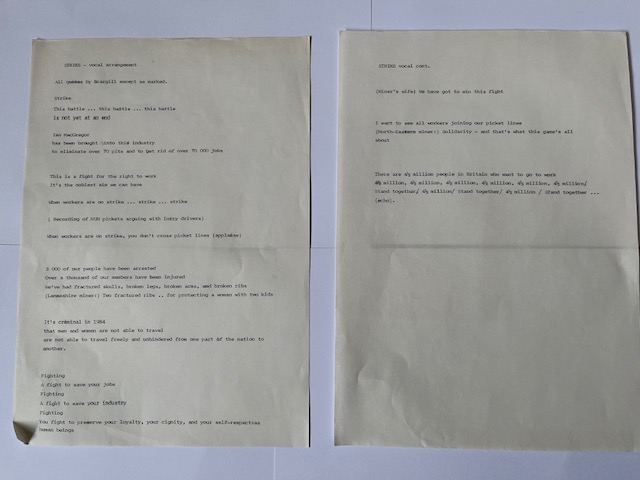
The edited extracts from Arthur Scargill's speeches and interviews with miners
Duguid and Kohn named themselves The Enemy Within, in direct reference to the phrase used by Prime Minister Margaret Thatcher to demean the efforts of the NUM. The pair took their plans to Island Records, but, reports Kohn, although the label was interested and went some way with it, the idea didn’t work out with them in the end.
Instead, they tried Rough Trade, a label known for its democratic ethos and left-leaning political sympathies. Through Rough Trade, they met the producer Adrian Sherwood. With the help of Keith LeBlanc, the ‘vocals’ and other sounds were added to a pre-existing LeBlanc bass track. The writer’s credit for the final product was given to LeBlanc, who was also, as it happens, the creator of ‘No Sell Out’.
‘Strike!’ was released through Rough Trade and the distributor The Cartel as RT 151 on 16 November 1984. It benefitted from a carefully designed marketing strategy from Rough Trade, who put a lot of work into the record, and a series of witty and bold press releases crafted by John Duguid. The first of these announced: ‘It’s the hardest dance record ever made and the first protest record in 20 years’ (Communique 1). A later one thanked the Prime Minister for promoting the Enemy Within in a speech she gave to the Carlton Club (Communique 2).
The accompanying advertising called on people to ‘Make This Record Number 1!’ In the spirit of the joke that spawned it, it was suggested that the Labour Party’s Young Socialists be recruited to hype the record into the charts, but they declined. ‘Apparently it wasn’t what they called music’, notes Kohn.
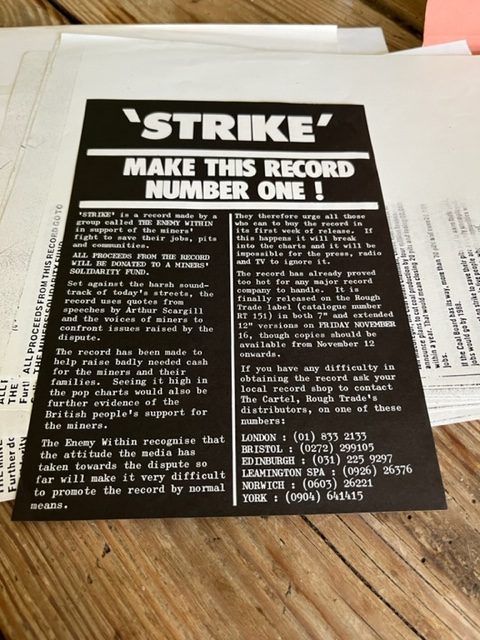
Advert for 'Strike!'
Others were more supportive. Cabaret Voltaire showed the video at their gigs, and there was considerable media support. As well as coverage provided by The Face, Richard Cook made it joint ‘Single of the Week’ in the NME. It also attracted the attention of papers as diverse as the Morning Star, The Financial Times and the Evening Standard. It didn’t become No. 1, but it made the second spot in the Music Week chart, kept off the top by ‘Nellie The Elephant’. And it featured in various Top Tens for several weeks (and No. 13 in David ‘Kid’ Jensen’s newspaper chart).
In his round-up of music for the year in the Sunday Times, Simon Frith declared ‘Strike!’ ‘The record of the year’, saying that it captured:
stutteringly, murkily, the emotional kernel of the miners’ strike, the frustration of people who are losing control of their industry and their lives. And translating frustration into spectacle has always been the function of rock and roll.
What Arthur Scargill thought of his contribution to all this is not known, but, as Kohn recalls, ‘we were in touch with his PA – I assume she told him! We wanted to make sure the NUM was OK with it, which I guess they were.’ With the help of sales of a video compilation, it brought in over £2,000 for miners’ charities (nearly £8,000 in today’s money). This was considerably less that raised by Band Aid’s ‘Do They Know it’s Christmas’, also released in late 1984, but arguably The Enemy Within got there first with the idea for a charity single and certainly had the more sophisticated politics (if perhaps utopian dreams: The Enemy Within asked everyone who bought their record to play it at 6pm every evening to create a surge of demand on the UK’s power system).
Despite mainstream media’s general opposition to the miners, the record was treated with amusement (but not mockery) and without signs of the rancour that greeted the strike itself.
Finally, what does ‘Strike!’ reveal about the phenomenon of the protest song? It provides further evidence of the general hypothesis that protest songs do not spring unbidden and unmediated from the conscience of the composer, nor are they the direct product of political circumstance. The insert included with ‘Strike!’ lists a number of acknowledgements, ranging from the head of Rough Trade to Nottingham Trades Council, to those involved in mixing, engineering and editing the record and the video, to partners and friends.
What was also notable about ‘Strike!’ was the media attention it garnered – not just the quantity, but the quality. Despite mainstream media’s general opposition to the miners, the record was treated with amusement (but not mockery) and without signs of the rancour that greeted the strike itself. One headline read ‘Greatest hits of Arthur Scargill’; and the Financial Times quoted the song’s ‘lyrics’ at length. And despite its almost brutalist aesthetic, ‘Strike!’ broke with the conventional wisdom of critics of the protest song by not just preaching to the converted.
Acknowledgement: This case study could not have been written without the considerable help of Marek Kohn. He very generously shared his memories and his archive.