
- February 10, 2022
- by John Street and Alan Finlayson
- 35 min. read
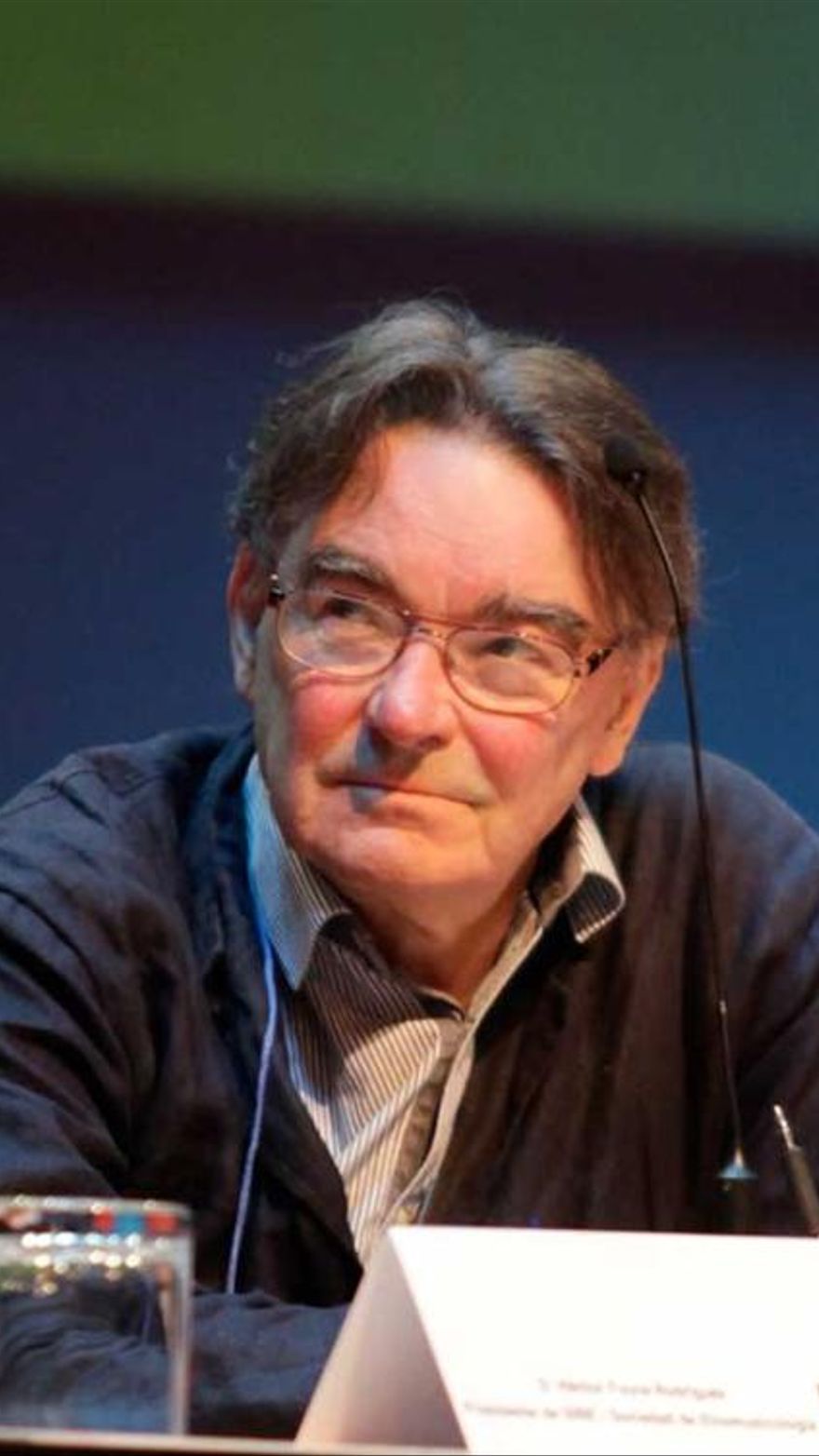
Simon Frith
OSV and Professor Simon Frith chew over the theory of protest song in rhetoric and performance.
Audio:
 Download
John Street
By way of introduction, it's very nice to have this conversation between Simon Frith, as author of Performing Rites, and Alan Finlayson from Political Studies and from the project Our Subversive Voice to talk about this idea that informs the the project: namely that in understanding the protest song we need to be conscious of its rhetorical devices and how it tries to persuade its audiences of the political messages or values that it's expressing or giving articulation to. So that's where we started. Simon, I wonder if you could begin by saying something – and I know Performing Rites source was written a long time ago, but it's been a hugely influential book – about how you came to think about rhetoric in relation to the song?
Simon Frith
I think it had two different things feeding into it, one negative and one positive. The negative thing was that by, well, certainly by the time I started writing both journalism and academic stuff on popular music, there was quite a well developed argument that you had to treat popular songs as poems. And there was quite early on, you know, studies, a big collection called The Poetry of Rock.
And you know, literary critics leaped on Bob Dylan as someone they could analyse as a literary person, and various people were seen as being poetic. And I always found, particularly as as critic and a listener, I always found this deeply dubious. Because I didn't think they did write very good poetry. I mean, that's not what I thought they were doing. And you know, you got suspicious when you read the poetry that Bob Dylan did write, for example, and thought, you know, it wasn't very good poetry! Which was kind of an irrelevancy.
But at the same time by coincidence I got a job in an English department.
Which ... Colin MacCabe had been professor at Strathclyde University – and so I had to start reading English Studies properly. But the interesting about that department because it was Colin and because he’d appointed two of his PhD students from Cambridge to the staff, was a very heavy emphasis on linguistics and linguistic theory.
So I got interested through that. And just because there were a lot of things that were going on being discussed on the kind of use of words in performance, rather than simply as literary texts, and so that got me to reading... not so much – I didn't really read very much on rhetoric since I looked on it as a classical term, but I had been thinking 'cause I was teaching a class about how we should go about thinking about words and songs – that became a chapter in the book – about: if we start out by saying the songs aren't poetry, but they're obviously very important in how they use words. And then think that what's involved in listening to a song is someone performing. And therefore the performance of the words is as crucial as the words themselves. And that doesn't mean they can't be poetry. Because clearly poetry can be performed and poetry is performed, even when you read it, in a sense, in a voice.
But on the other hand, I thought, popular music is interesting, 'cause a voice is part of the sales pitch as well.
So the rhetoric is not just about whatever the politics may be, but it's also the kind of rhetoric which actually does go back to Gerry Adams and Paisley – of presenting a self, through which the words made sense.
So I became interested in rhetoric as a kind of way in which performed songs are performed, and understanding how we can't possibly listen to them except under some notion that someone is talking to us and trying to persuade us to do something.
But of course, I mean, I think the interesting thing from the point of view of protest song is that rhetoric is not controllable very easily. And you can have a wonderful rhetorical song which makes you feel good about something, So it's very easy for somebody who wants you to make you feel good about something that was not the intention at all.
I mean, this is a classic example of Bruce Springsteen’s ‘Born in the USA’. It was a wonderful piece of rhetoric about being proud to be American. And so regardless of what he thought about that, you know, it made sense to a kind of Reaganite Republican party, that this is what it was about. So I thought once you get into that rhetorical thing, it becomes much trickier to say precisely ... I mean, you can analyse how the rhetoric works but you can't necessarily... you still have to put it in the context of where it's being used, which means I mean every time Paisley gave a speech there was an audience, and he was addressing the audience.
So I think the thing I never really developed, because I wasn't really doing nearly as much on live performance as I did later, is that one of the things that becomes interesting is that performance is something you see as well as you hear.
I think rhetoric is very interesting in thinking a bit about how the gestures ... there are some very nice YouTube clips; One of them, which is about how to play the electric guitar. I don’t know if you’ve seen this? He says, ‘you have to make your face like you’ve got a nasty smell under your nose.’ And so it's very funnyAnd then somebody else put up a thing saying ‘trying to play an electric guitar solo with no facial expression whatsoever.’ And you can see how incredibly difficult it is; his mouth just keeps twitching – and also how incredibly boring it is!
You need all those expressions on the face, so I got very interested in how musicians kind of indicate what they're feeling by their movements and so on. So I think rhetoric became interesting to me, not that I analyse it in that chapter, but there's an aspect of performance which then ties in with what you know about the performer and so on.
So that's really the starting – It kind of, in an odd kind of way, it came out of not wanting to regard pop songs as poems – as a starting point.
John I mean you do talk in some sense about accent in relation to song, as examples perhaps of the ways in which gestures and the person is embodied in in song and in rhetoric. It reminded me, by the way, that those ambiguities of the song in performance, is that if you were watching, which you probably weren't, Norwich City playing Aston Villa last night, you will have heard the Aston Villa fans singing ‘We Shall Overcome’, for no very good and obvious reason of protest, since they were, they were two nil up. But anyway.
Simon
Did they win? Well, quite right.
John
Alan, I mean, what about from your perspective? What Simon is saying about rhetoric in relation to song – does that chime with the way in which you think about rhetoric in relation to political speeches?
Alan Finlayson
At the risk of making my career sound coherent or as impressive as Simon’s, I would say that as a political theorist, one of the things I was trained in is reading texts as political philosophy, and thinking very hard about the arguments they're making and how those work. And there are some currents of political theory that pay attention to the rhetoric of those works and thinking of Quentin Skinner, for instance, the historian of political thought, for whom one of the questions we can ask of political theory texts is: what were they trying to intervene into and how are they doing that through their uses of language?
So I think from there I became interested in other instances of political rhetoric as instances of a kind of political thinking. Looking at political speeches and saying what's going on here, what kind of political thought is this?
And in a way, maybe it's the reverse of what Simon was doing, because then you can't say that a political speech, it's not a wrought work of political philosophy, and it can't be expected to be such a work. It's going to be doing things in a different, different way, while still employing ideas and arguments. So in that sense, I wanted to slightly elevate political rhetoric, and say it's not just cliched repetitions. I mean, it might be, but it doesn't have to be! It's trying, it's trying to do something very specific with political ideas, which is [to] present them in a way that might be successfully persuasive, or that applies them in a way that is successfully persuasive, I should say, because that's more often what's happening.
Some set of values or concepts are being applied to make an argument about a particular thing. We should raise taxes or not raise taxes. Go to war or not go to war, or whatever it might be. So that's what got me interested in rhetoric, and from there being interested in all sorts of ways in which people express themselves and express their politics. How do they do that? And what are the conditions of doing that? And how does that, how can that be understood as rhetoric? And how does that work rhetorically?
So, interestingly, that does lead me to converge on the point of performance. Some part of that might be looking at speech as texts from particular moments, and reading them historically. But then it's also thinking about their performance in the text or the performance of the speech as a live event.
Partly because that focuses you on the particular moment that the words are trying to intervene into and shape, but then also does draw attention to these ideas of performance – the voice and the tone and the gestures – which you can, you know, there are strong currents now in cultural sociology that think about politics as performance in this sort of way: how is a political figure trying to play a role that people will recognise?
Maybe there's an embodiment of some kind of archetype, a strong leader, or you know, the hero struggling against dark forces. The kind of plain-spoken teller of truth or these kinds of things, and those are a central part of what goes on in those kinds of rhetorical actions. Part of the argument is, believe me, you can rely on me, you can trust me because I'm this kind of person. There’s an attempt to build a sort of performative unity of the character that the politician is playing, along with the arguments they're making, and the promises that they're offering and the proposals they're making.
So for me when it came to thinking about protest song it was sort of an extension of that – it was, what kinds of political expression are these; in what ways are these workings political rhetoric? And I suppose part of that is also a sort of question: well, what would these look like if I treated them as political speeches? I suppose you could say. But also then, since they aren't political speeches, in what ways are they not political speeches? And what does that tell me about both songs and about political speeches, and that's part of what over the course of the project I think has become more important for me, I suppose, is the ways in which the the songs are at one level limited in comparison to speeches – because they can't be as long and they can't be as detailed and they can't do certain things – but on the other hand they also have creative opportunities that are not available to the political speech.
So in a funny way I've ended up ... I started out looking at political songs as political speeches and I now find myself looking at speeches and thinking about them as songs!
Simon
I mean, I think that really interesting. I would say there's kind of three things, just thinking about songs and how they're not speeches.
On the whole most political songs, and most pop songs, are not really designed to change the mind of people who are listening to them.
Because of the way the market works – they're appealing to either an audience the artist already has, or to the kind of audience that already exists that the artist is sort of addressing, so you don't very often get political rhetoric in songs, which could be designed to win over people haven't thought about this or ... maybe in some early songs within, you know, the feminist movement, that was possible. But I suspect the earliest onew were for feminists audiences. Again, it was a form of solidarity. Which I think much of political rhetoric is of course.
I mean, most people who make speeches these days are speaking to their own party members. It becomes interesting when you get to the modern world and how politicians have to think about how they're going to address the nation, which is a different sort of rhetoric, which means that they are, you know, they're not just addressing their fans so to speak. And the difficulties with that, and I think on the whole it would be interesting to think of any political songs in your protest songs that were clearly written and designed to be heard by people who wouldn't have agreed with them, and how that worked.
So that's one problem. That's one interesting thing.
The second is that, going back to why speeches can’t be songs and songs can’t be speeches, is of course songs are listened to over and over again.
Which on the whole ... I mean there are politicians who give the same speech – might be many politicians, probably who give the same speech over and over again. But it's sort of live. You don't put out a recording of your speech until usually long after you're dead and people are now sort of fetishising, you know, ‘I have a dream’—
Alan
Yes, although people did used to release pamphlets of them, texts of them; that was a big part of 18th-century politics.
Simon
Wow, well that would be worth looking at – how that text reads from a historical point of view – you can read the text, but we obviously can't hear the speech.
Alan
No.
Simon
So how much you could get the speech from the reading is quite an interesting question
So that's another issue for the song. It also means that that rhetorical thing in the song is being listened to in a lot of different contexts. I mean a political speech is on the whole being delivered in a sort of public place.
And so that's the other thing which I think is tricky about the rhetoric of protest songs is that there's a peculiar relationship between the fact that you are listening publicly and the fact that you're listening privately. So many people songs that people love as protest songs or songs that they play to themselves alone at night in their bedrooms. You know, and so it’s a very different rhetorical situation than watching them doing it on stage.
Alan
Part of what's interesting about political rhetoric right now is how the conditions of its production and reception are changing. So that speeches are often heard as recordings in different ways. Clips on the news and so forth repeated—
Simon
Yeah.
Alan
—But also very recently, and if we take political speech [to] not just be those set piece speeches when politicians present, but other contexts of political argument, there's quite a lot of that on YouTube, for example, which people are watching alone and maybe even watching more than once in some odd cases. So there are different ways in which ... and I do think as a sort of side note, part of what strikes me as a characteristic of politics right now is the ways in which in some respects political argument is becoming a source of subcultural affiliation, in the way that music used to be, because you can find it and listen to it and share it and talk to other fans about it online. You can go to your Reddit group and say what does this bit mean in what Jordan Peterson said? or something like this. So there's something interesting going on there, and I think that's linked to to stuff that John's written about how politics and celebrity culture get blended and entertainment culture get blended. There's some quite deep shifts going on.
And that's a problem for political speech makers, as it were, and argument crafters; the fact that your arguments are going to be lifted out and employed in different contexts and heard in different contexts. So how do you deal with that? Because things that might make sense to your trade union audience, or your audience of veterans, might then might not make sense when they’re crossed over from one to the other. So there's great difficulty there.
Simon
Well, I mean an interesting example of that is when Angela Rayner called Tories scum, which in the context of a speech to Labour people obviously went down a bomb, but then it instantly became a deep embarrassment. That was the one line that was taken out of it.
Alan
Exactly – and what in the context might have seemed appropriate, you know, thrown at you over the breakfast table suddenly seems extreme, doesn't it?
But I want to come back to your argument about whether the speeches win people over or songs win people over because maybe they're all designed for sort of audiences who already share them.
I suppose we could think of examples or songs where people thought they might be able to persuade somebody, but perhaps more interesting is the songs that were trying to win over or speak to people who were not on any side; who had not yet formed their thoughts, because that's an important part of political ... there are these very sharp moments when political rhetoric might be: vote for this, vote for that. Vote it up, vote it down, whatever. But then there's all sorts of other kind of rhetorics going on all the time that are generally circulating and promoting arguments, ways of thinking about political life, economic situations, and so forth.
And that sort of ongoing rhetoric is quite important in providing vocabularies through which people think about their own political situation or think about the national political situation and so forth, and one of the most important effects of political speeches can be that actually – a little phrase that comes out and becomes separate from the speech, in a way, but naming a situation, whether that's a Margaret Thatcher talking about ‘the enemy within’, or David Cameron talking about ‘don't vote for chaos with Ed Miliband’ or something like that – these are fragments, so speeches that come out and sort of take a position but more deeply, there are ways of naming situations. As you know, crises or as opportunities and so forth.
And it seems to me that that is often addressed at people who are not yet sure what they think, and are looking for a way to think. And it seems to me that songs maybe could be quite important vehicles for that.
Simon
I think the most obvious example is nationalism. I mean if you were to look at the history of Scottish nationalism I think you would find ... I mean for me, one of the most interesting protest songwriters to look at is The Proclaimers. Because their songs clearly in one sense were assuming a Scottish audience – you know, ‘Letter from America’ where they always reference towards what’s been enclosed and clearances and then deindustrialisation – everybody in the Scottish audience knew instantly what they were talking about and the fact that they were singing in in clear Scottish accents gave them that sort of ‘we’ feeling.
But I think certainly when they started they were not regarded as significant in, you know in the music establishment or in the political establishment, but in a sense they helped to establish a way of thinking about Scotland as a nation that did have its own political impact.
So I think you're right. I mean, there are certainly political issues which songs can be very helpful in giving people a kind of a recognition in a sense of something they haven't thought about or a way, a kind of shift about ... I mean, I think that was an interesting period because it was a kind of a shift from socialism to nationalism, in terms of being radical in Scotland. Which happened around the time I moved there so that you know anti-poll tax and anti-Thatcher morphed into ‘we must have an independent Scotland because we can't deal with, can't let them go causing us problems’.
And I think some songs were very significant for that. So I agree with you on that, absolutely.
Alan
But I suppose The Proclaimers’ songs in that sense are being slightly indirectly political in terms of their presentation of perspective.
Simon
Yes, and I think they would have thought of them as political.
Alan
Yes, I'm sure, and then we could have a sort of continuum between that and then the songs that are a bit more explicitly trying to provide some kind of definition of Thatcherism or definition of capitalism or definition of labour and make that stick.
Simon
I think The Proclaimers gave people a way of thinking. I don't think they necessarily gave them a new vocabulary.
Alan
To pursue that point about vocabulary and a new way of thinking, I mean, what you write about a lot – in Performing Rites, but [also] elsewhere, I think, that seems to be your go-to example, but I think that’s because it’s the go-to example for lots of people – is love songs.
You say something about how these songs can provide people with a vocabulary to articulate their experience, perhaps to each other or to themselves?
But you don't then kind of apply that to the protest song, when it seems when you could – that the protest song in a sense works in exactly the same way. It provides a set of terms, and often clichéd terms, but powerful terms nonetheless. Well, precisely 'cause they are clichés, perhaps, for thinking about social and political situations. And that says they are providing a vocabulary through which we understand things that are perhaps, like love, too overwhelming, or too complicated—
Simon
I don't think this would necessarily be my argument, but I'll just make it here.
One could say that this becomes particularly significant for identity politics.
Which is what love songs are about: about a way of expressing one's immediate ‘being in love identity’.
And that's what a lot of American stuff ... as you mentioned at the beginning, more American literature on this would look at things like civil rights, or things, and that's kind of an identity movement [in which] songs become very important.
I think it's trickier to think of songs working quite like that in political party terms.
We tend to think of protest songs as things like CND or climate change or whatever, rather than thinking ... I guess early on in the 19th century there would have been much more clear working-class experience, you know – the industrial worker songs, again about the experience of being something rather than being a party.
Alan
Well, we can come back to that in terms of what the project is showing. I would argue that one of the most important things political rhetoric does is provide definitions. It's even kind of in the classical canon of rhetoric.
One of the kind of opening forms of argumentation is to define, as it is in philosophy, science and so forth. You provide definitions of situations, sometimes explicitly, sometimes implicitly, from which it then becomes logical that certain conclusions follow. If you convince people that another country is an imminent threat, it becomes obvious what the policy solution is.
In addition to identity politics, it seems to me there are lots of songs that are doing that. So The Specials’ ‘Ghost Town’ is on our list. And what does that song do? Well, it's making a a proposition about what the situation is. This is what it's like in this city now. This is what's happening. It's becoming like a ghost town.
That's providing a definition of a situation which is clearly not the definition that the government of the time would’ve made. From which ... now it doesn't necessarily explicitly articulate in the song what should follow. But it does kind of imply certain things. It becomes part of a wider moment, and I think you could think about other kinds of songs that do that.
They could be nationalist songs. In a way, that's what The Proclaimers are doing. It could be other kinds of songs about – yeah, sexual liberation ... It could be feminist songs. Part what they're doing is saying no, this thing you thought was like this, it's like this. That's a fundamental rhetorical operation: to say this thing you thought was was natural, is not natural – or this thing you thought was acceptable, is not acceptable. This person you thought couldn't have rights, actually can have rights.
I think that's a very important part of what these songs can do. Lyrically, but also, to come back to your core point, in the performance as well. That can often be an absolutely vital part of what is going on in those songs.
Simon
An additional problem here is that they are actually music. So ‘Ghost Town’ is a very peculiar song because the music is kind of jolly. And everyone knows that little riff immediately. And you know, I remember, 'cause obviously ... I was living in Coventry at the time that came out. So I mean it was pretty accurate about what it was like. But it was also pretty accurate to the fact that it was fun making music in Coventry at that time.
The Specials became very big and there was always a funny edge on that and it was like you know, was designed to be a commercial big hit, which it was.
When I started teaching at Strathclyde it was the first time I’d really taught popular music for masters students, who were very international, so we actually had a class where everybody had to bring in what they regarded as a protest song in their own culture – a very early version of John’s thing! – which was pretty well fairly standard for what you'd expect. But there was a guy there from South Korea.
At one stage in South Korean history there were huge number of demonstrations, by students, particularly, with a lot of police violence. And he was an interesting young man because his father was a policeman. But he'd been a student leader. Being involved in places where he got beaten and so on. So he brought in the piece of music that for him stood for that moment in his life. So we all sat there eagerly to see what it was. It was a song by Smokey!
And I thought this is bizarre beyond belief, and he said they would gather in someone’s flat ready for the fight that they knew was going to happen, and they would play that song because it was a perfect calming mood. And he could feel like they could be slightly detached from reality and then go out and face it.
And I thought this was so bizarre that I actually called up Smokey’s manager and said, can this possibly be true? And he said, it's really interesting you say that because they never did anything very internationally, but they're huge in South Korea.
And I was thinking that at the time – I never did anything much with that – but I always thought it would be very hard to write some to write an account of a Smokey song in terms of political rhetoric. Although for him it was a protest song in terms of morale boosting, but of course it wasn't a song ... they could gather together in a flat and listen to it, or [in] someone’s room. [But] it wasn't a song that they would sing while they were marching. It was a different sort of political effect.
Alan
Yeah, that's something we've been quite conscious of with the project I think – is the ways in which music is used politically are perhaps slightly different from the protest song. And as you say it, all kinds of songs can be used in all kinds of ways by collectives about to act in some way, or by individuals looking for some affirmation. That's clearly an important part of the politics of popular music.
Which is different, though, from thinking about popular music as politics if that makes sense – as a kind of conscious attempt to intervene into something. Which people are clearly doing. I mean clearly songwriters are at some level thinking consciously: here's a thing going on that I disagree with or want to oppose or want to support, and they are trying to express some position on that.
Simon
Yeah, I suppose to think about music is interesting. I mean clearly from your analysis of political rhetoric, elements like rhyme and rhythm are always deeply important to how speech works. But there's an odd sort of way in which music is sort of in a sense more dictatorial.
I suppose simple folk song protest songs, they didn't have – you know, other than the fact that they perhaps had a rhyming compulsion – there was no particular rule, you could go on, you know, the song might last 30 minutes. But once you get to kind of pop song rules, there are certain constraints.
That’s why ‘Ghost Town’ is interesting: its appeal is because it fitted itself into a certain sort of musical framework, which wasn't necessarily the rhetorical framework you would imagine.
You feel a good public speaker understands the rhythm of their own voice and and how to use repetition, all those things, whereas in the protest song, it's often collectively produced, musically.
And the other people in the band may or may not have any interest whatsoever in what the writer’s getting obsessed about.
It's a complication, it doesn't affect what you're doing. But I think it means that the history of protest song with changing musical styles and fashions would have to be taken into account. 'Cause I think we sometimes think protest song equals folk song.
Alan
Yes, now that's absolutely not our criteria, because our criteria are ‘what it's saying’. They are driven by the lyrical content that we're conscious [of], and that that means certain things get excluded. But you know you're absolutely right. Because part of what's interesting is how certain musical genres become associated with the protest song. You can signal the protest song. You know there’s that Morrissey line about, ‘I thought if you had an acoustic guitar, then it meant that you were / A protest singer.’
And part of what we wanted to get away from was exactly that, but then that becomes an interesting question about how that came to define a certain form and the politics of that, which are in a sense familiar – a certain idea of authenticity and not technological and so forth.
But the other part of our project then, you see, it's not just to look at English songs, but also to look at songs from 16— ... I think our earliest song is 1602? 1603. By putting it into that much longer context, you immediately displace the idea that the protest song is a post war phenomenon of a certain political, generational commercial conjuncture.
And then that brings in all sorts of other complicated questions about what is going on, but it brings me back to the point you made earlier about the 19th century 'cause the long story seems to be – I say seems 'cause we haven't settled yet – that in that early period in the 17th century you do have quite a thriving commercial market, for ballads and other kinds of songs that are clearly commenting on and intervening into political situations, and are quite heavily sort of authored by individuals. Although they would have been performed by all kinds of different individuals. Some of which are directly connected to particular moments, which might include demonstrations and certain political contests. Moments of political contest, particular in the Civil War, and around religion.
And then what seems to happen is that as you get into the 19th century, things change and you begin to get what you were talking about earlier. More instances of collective songs where the songs become anthems, hymns, that are for marching, whether that's military or working-class protest, and then the emergence of party songs too. And trade union songs.
And its this very different moment where they are about affirming that kind of collective identity and experience through song as well as binding people intellectually, ideologically, to the movement too.
And then that continues into the 20th century. It's that which then fades and is broken by the post-war situation. So that ... which in a way is a return to an earlier moment of a certain kind of song that thinks of itself as being political, though it has a different kind of self consciousness of that.
Although I think we would wanna argue that then things have changed again in terms of ... because of the sheer variety of forms and styles through which people are communicating politically. So there are these different moments where you see these different kinds of songs doing these different kinds of things. Without wanting to make that too tight or too teleological a story.
Simon
I've always thought it was interesting that as far as I can see, Britain in the 20th century never really had the tradition of chanson or Lieder or the equivalents that you have in Scandinavian countries, of kind of educated, popular songwriters writing with an eye on poetry and an eye on politics. Whereas that songwriting skill seems to have gone into musical theatre in Britain. So you do get some some some musicals which are political, but you get nothing like the sort of Brecht/Weil type. I've never really understood quite why.
It was quite interesting that somebody like Gracie Fields, who was capable of singing, you know, on the same night in a music hall for a working-class audience and then at a café for a middle-class audience. But her songs were all very kind of working-class girl songs. I don't think she ever wrote a song that one could think vaguely was protest song, even though some of her movies were about working-class solidarity and things.
So I don't know what happened to that song tradition, it sort of pops up here and there, but...
You get that peculiar person who I used to hate 'cause I hated his voice. Jake Thackeray. Made a career out of singing chansons in English.
John
I think the only thing we've we've come across from the ’50s and ’60s is the Festival of Fools, which was something that Peggy Seeger and Ewan MacColl used to run out of their Critics Group, which was a sort of revue that involved them in political songwriting which was more of that tradition of humorous song, not strictly the chanson, but certainly those ones where you were writing for a kind of, the musical theatre rather than for—
Simon
Yeah. I mean, I suppose the other person – and I have no idea who wrote her songs – was Millicent Martin on That Is The Week That Was, which would have a political song at the end.
Alan
Yeah, I think that’s the only example, but it's sort of comedy song, you find that but you don’t find the chanson-type songs.
Can we go back to something you started with? It's always the core of the Frithian approach.
You talked about the songs as performances of self. Which obviously comes out of your analysis of the ways in which they worked rhetorically as these ... in which the singer’s accent and their bearing and how they play the guitar, all of which is part of communicating the meaning, and may in fact be part of ... the songs might be there in part to sustain that performance and to communicate that experience...
So in rhetoric we would again talk about that and that might be something like the the construction of the appeal to ethos. How does the quality of the political speaker – they’re not just all politicians – present a self that we want to listen to; that we think might be worth listening to; be authoritative or reliable, or be on our side?
You know, rhetoric scholars would often call it identification.
How does the speaker establish a level of commonality with the people they're speaking to, so [that] there's some reason to think they might be on your side?
But then one can complicate that rhetorically, because what a speech is also doing is inviting the audience to adopt that persona in some way, or to become that kind of person.
In some forms of politics that's directly identify with the leader or through them. That's a certain kind of populist or authoritarian politics.
But it may be that that the proposition the speaker is making are more – these are moral positions, and if you adhere to these positions, you are a moral person.
Or they might be making arguments about something to do with aspiration and self-improvement.
And part of the promise is that if you agree with these propositions you become one of those aspirational successful entrepreneurial people. To put it kind of loosely.
That's part of what's going on. A speech is asking you to identify yourself as a certain sort of person and to want to be that person – so to agree with the speech – or to want to become that person through supporting the proposition it's making and the policies it wants to put in place.
Anyway, that's a bit rambly. The point is, don't protest songs do the same thing? That in part what we're being asked to do, is to take on or share or become part of the character of the performer or the character in the voice of the song?
Particularly 'cause we sing along with songs, and we sing along with them in private as well or in our heads, even silently, and in so doing we're taking on some kind of subject position, some kind of identity, and performing that in some way in our in our minds.
And that might be something that is quite, potentially quite important in songs. I think that's clearly something going on in love songs, for example: people are trying on roles and experiences. Can that be an important part of the political protest song?
Simon
Yes, I think I would throw in one complicating factor, which I also had in Performing Rites, which is people's suspicion of people who are very articulate.
And therefore it’s a tricky issue for the rhetoric. I mean, I was thinking that 'cause we were just talking about British comic songs. If you read, say, P.G. Wodehouse on ... I think the character’s called [Sir Roderick] Spode his kind of thinly-disguised [Oswald] Mosley. One of the things he's interested in is how the real person is nothing like the person who goes out and does this wonderful leadership.
Which is a way that, one way that the British responded to Hitler. To laugh at the real person. Or indeed the way in which the Left laughed at Trump. You know, you have a notion there's this silly little man there. And then there's this great rhetoric.
And this is ... it's not exactly hypocrisy, but the rhetoric becomes seen as an act [in] which you can admire the act but not admire the person.
I think it's interesting therefore that, I think there's a kind of pressure on – in both music and in rhetoric – that notion of how you convey sincerity.
Which seems to be an important part of why someone would believe what you're saying: ’cause you think they mean it, rather than 'cause they’re just saying it because they get money for it or whatever.
And I think the rhetoric of somebody like Greta Thunberg is interesting to look at.
She obviously is saying what she thinks, but it's the style which is so different from the politician she's ... and she is interesting. She tends to be simultaneously addressing politicians and talking about ‘we’ as young people.
It's very effective, but it's partly effective because she's not talking like a politician.
So I think, going back to your point, I mean I think it's true what you're saying, but I quite agree. I mean, I think if you go back to Bob Dylan’s protest era, a lot of people, including me, as teenagers, kind of felt he spoke for us. It was because he wasn't completely articulate. Because you had images and you had no idea what they were on about.
You felt there was somebody who felt those things, and was giving voice to them.
So I think there's that – particularly among the British – people who can talk very, very cleverly and their rhetoric is perfect ... I mean, I think that's one reason why Boris [Johnson] has been able to get people thinking he's a good guy because his very incompetence becomes the mark of, well he’s just like us, he makes mistakes or...
Alan
I think that's right. There's definitely a phenomenon at the moment is that one establishes one’s rhetorical credibility by breaking with the conventions of traditional speech. Trump does that, Johnson, lots of people do that, and that becomes a way of performing your critique of the political establishment.
John
Just to say, there is an interesting example which Alan’s written about, which is Dave’s song ‘Question Time’. It’s an interesting example of where, as it were, he presents himself as the ordinary person and refers to his mother as kind of validating the kind of work that she does, as against that that Theresa May etc. –the objects of his interrogation – have clearly failed to do. I think that, it seems to me that's quite an interesting example of how you convey a form of representative authenticity.
The tone of the voice as much as, as well as the formal questioning.
Alan
But there are these moments definitely where, I mean, in a sense it doesn't necessarily rely on the sincerity of the singer. It's the sincerity of the song, as a construction—
Simon
Yeah, that’s a very tricky thing to analyse. I agree with you.
Alan
—In which we identify with and through it. It’s a very obvious example that I keep coming back to on the project is Tom Robinson’s ‘Glad to be Gay’.
Which asks you, requires of you to sing that you're glad to be gay, so that's then putting ... so it's doing quite a lot of work, that song, both in kind of characterising certain situations as oppression in a very kind of sarcastic way while also inviting people to join in in a chorus, the articulation of which implicates them in a – some kind of social and political position.
Simon
He himself was very clear that he knew that that would involve lots of people who are anti-gay singing ‘I'm glad to be gay’.
Alan
Exactly exactly, yeah, yeah, yeah, exactly.
We've interviewed Billy Bragg, so Billy Bragg's ‘Between the Wars’, which starts with ‘I’. ‘I was a miner’.
Who's the I in that song? We know it's not Billy Bragg. No one thinks it's Billy Bragg. So who is it? When we sing it, who is it?
So the song creates some moment for some kind of identification, of us the audience humming along with the song, with a kind of archetypal list of certain kinds of people and certain kinds of politics.
Simon
That was always the folk tradition. It’s the song that matters, not the singer.
Alan
But rhetorically the use of the pronouns and the appeal of the descriptions implicates people in, at least in some sense, adopting an imagined kind of position.
It's not going to make anyone suddenly ... they're not all going to go out and apply to be miners or dockers, nor are they necessarily going to join trade unions.
But it we might say that it's providing some kind of orientation, and through that a vocabulary, through which people might think about their politics.
Now in the case of that song, because that song is partly self-consciously trying to sound like a certain sort of song, and is written to sound like that sort of song, there are complications in there in which it can become kind of more of an elegy than a, than a celebration. In fact, he told us in the interview that he stopped playing that song at concerts because he felt people were singing along and being nostalgic for the Thatcherite era, of which it was a part.
Simon
I mean, I think it's in, in terms of rhetorical narratives it’s the problematic notion of character. which you know takes you more on to kind of stage performance.
There is a character giving the speech, and whether or not you think the character is a version the person speaking, or is quite clearly an enactment of the person speaking, which I think a lot of songs do.
It doesn't make the analysis impossible. But I can see you ending up with a whole lot of different categories of different sorts of protest songs.
Alan
Yes, exactly. There are certain songs where everyone is invited to sing along, so there's complications there in terms of, which character are you? I don't know – in Peter Gabriel’s ‘Biko’ for example, invites people to sing along. So what character are they?
He’s partly requiring people then to sing along to make certain kinds of pledges, and whether anything follows from that is a different question.
So I think there are those songs, as opposed to songs that are perhaps a little bit more, loosely speaking, didactic, in terms of saying, think of it this way, see it this way. Which is what you're more likely to get, I would say, in Crass songs for example, though our colleague might disagree with me, but I think they're a little bit more didactic actually, in terms of saying, this is what's going on, these people are murderers. These people are evil.
Simon
I mean I can’t remember ‘Biko’ at all. I can’t even remember what the tune was.
But I think it goes back to something you were saying earlier, which I think is, you know, the art of a good protest song is having a phrase that you remember. It was ‘Free Nelson Mandela’, or ‘Ghost Town’ or whatever it might be. Just as you were saying in political speeches you come up with a phrase.
That's one of the arts of protest song writing is – produced the phrase that people remember even when they don’t remember the song. Whereas ‘Biko’ – I can’t remember any of the phrases.
Alan
I'm not going to sing it.
John
Where you cannot sing ‘Glad to be Gay’ without intending to join in and in support of it, you can sing ‘Part of the Union’ or ‘Born in the USA’ – I mean, in other words, be singing with people who disagree with you fundamentally about what it is you're celebrating.
So there are differences in which a phrase can work, or a slogan can work—
Simon
Well, that's true of speech phrases as well isn’t it? I mean, ‘the enemy within’ becomes a phrase where people are proud to be the enemy within, you know, make records with that name, and—
Alan
And presumably part of what's happening in the Springsteen case is that, for the song to be effective, it has to draw on a certain kind of cliché.
And the cliché is just too strong. He can't, he can't wrestle it away from—
Simon
But also his own confusion 'cause he is proud to be American.
Alan
Yes, that's true.
Simon
I think Billy Bragg’s very interesting in trying to think of what an English national identity is, which I don't think he's managed, but you can see what his problem is.
To want to be proclaiming Englishness while not wanting to proclaim Englishness in the way anybody else does it.
It’s dead easy in Scotland 'cause you're just anti-English.
Alan
So some of the earliest songs in our canon are in fact about Scotland. There's quite a lot of early songs that are critiquing the influx of Scots when James becomes king in London, and complaining about all these kind of rough Scots coming in and lording it about and dressing up in fancy clothes and such like.
Which sort of brings me to the next point I was gonna ask here, because I do think – to go back to my political thinking – part of what I would be interested in in rhetoric is also a sort of rhetorical history.
Speeches, to work, have to draw on some set of commonly understood resources and then part of what they can achieve is to create a new resource that subsequent speech makers can use and can think about, or employ in their speeches. I don't want to make this point too strongly 'cause I don't know if I can sustain it over the whole of our period, but you do find in those very early songs a vocabulary of contempt for politicians that seems remarkably persistent and consistent.
Partly because it’s a fairly classical rhetorical technique, which is, you know, to divide the character of the politician from their claims to show that they are purveyors of vice not virtue, but also to do that by connecting them with luxury and indulgence. To do that by connecting them to sexual licence, that sort of thing.
You get quite a lot of songs that are about the clothes, the food, that whoever it is you're attacking is consuming. Which makes sense in 17th-century England because they've got all the food and fancy clothes and you're stuck with very little.
But then persists. So you do find it even in very contemporary songs where politicians are shown to lack sympathy for everyday people, for ... to lack sympathy for victims of something. And that's shown by the fact that they have nice cars, nice houses, speak in a certain way. There's this tremendous consistency.
So that makes me wonder if that's something important songs do. They’re not the only thing that does that, but they are one of the means of communication that perpetuates and keeps in circulation certain kinds of fragments of argument.
Which newspaper columnists do and jokes do. And movies and sitcoms and TV – everything does it in a sense.
But then keeps these circulating around with interesting historical development, that can then be employed by other songwriters or other political rhetoricians. And I think that's possibly ... am I going to say the most important? A very important part of what the songs are doing, creating these vocabularies, keeping them around, that then get used by others making more specific arguments – does that make sense?
Simon
Yeah, and I would throw in another aspect of this because it has musical reference, which is Protestantism.
Because if you look at the Reformation, part of what's going on, is the denunciation of the Catholic Church for its wealth, sexual excesses, all the things you just said.
The kind of Low Church movement in various forms has retained that sort of denunciation of the rich and the powerful, and you know that fed in them and they they don't seem like protest songs to us now but fit into a certain sort of Protestant hymnal.
That sort of rhetorical poor-versus-rich, in very broad terms, has kept going in music circles for a very long time.
Of course it becomes problematic in rock terms because the singers are part ... are rich.
I read an interesting article by a guy who'd looked at U2 as a political group.
And was looking at what they, how they dealt with the fact that having had a record that very much praised the woman from Myanmar—
Alan
—Aung San Suu Kyi—
Simon
—who was one of their heroines, and they had, you know, an image of her in the show. And then when it came out that she, you know, her ignoring the human rights of part of her population, and she suddenly became not a great mythical good person, U2 were stuck with still having her as part of their rhetoric on stage.
So they had to make some sort of adjustment, in the knowledge that they didn't quite believe this any more.
And it was actually quite difficult for them because rhetorically she was built into a sort of uplift and they had to have a special video made like as a footnote. And Bono had to give a little speech about it, which completely undermined, you know, the sort of way they like to get their crowd all united around something.
It was an interesting analysis of the problems with political rhetoric when it doesn't seem so convincing as it did when you wrote it.
John
Simon I'm very conscious that we’ve kept you for a full hour now and we probably should allow you a break.
Thank you ever so much for talking to us about Performing Rites and the protest song.
Simon Frith OBE is Emeritus Professor of Music at the University of Edinburgh, as well as a journalist, editor, and – from 1992 to 2016 – chair of the judges for the Mercury Music Prize. His personal antipathy to the unique vocal stylings of Jake Thackeray does not reflect the views of OSV as a whole.
Simon Frith, University of Edinburgh