
- February 10, 2022
- by Oskar Cox Jensen
- 7 min. read
Bluestockings and Red Flags: Women’s Protest Songwriting Before the Suffragettes
An introduction to women's protest songwriting before 1900 – from anonymous ballads to subversive hymns
Of all the women in our history of English protest song, the suffragettes sing loudest. The later twentieth and twenty-first centuries are packed, of course (though still, proportionately, much less than they should be) and the Greenham Common Peace Camp runs them close, but it is impossible to close your ears to the great chorus of voices from the 1900s and 1910s, pouring eloquence and anger into military marches, hymns, and compositions from great composers like Ethel Smyth and Alicia Needham.
Though often, to modern ears, surprisingly patriotic, even nationalistic or imperialist, these songs of suffrage are themselves indebted to the techniques and energy of late-nineteenth-century socialism and secularism. Though sometimes politically at odds, these earlier songs developed the high-blown rhetorical style and regimented, piano-led musical arrangements that would also characterise the chants of the suffragettes. Though the prime movers in this instance were the likes of William Morris and Edward Carpenter, the fin de siècle was distinguished by composers such as Emily Josephine Troup – more of whom later – and lyricists like the famed novelist Edith Nesbit.
Nesbit’s ‘Come Gather, O People’ is exemplary. It was expertly set to ‘Hearts of Oak’, a stalwart Georgian theatre tune and anthem that, for a century at least, rivalled ‘Rule, Britannia!’ and ‘God Save the King/Queen’ in popularity. Nesbit subverts the tune’s usually patriotic, royalist flavour whilst taking advantage of its infectious verse and iconic chorus. Beneath its somewhat florid flavour there is strong ‘cradle to grave’ rhetoric that manages to negotiate a position that is at once revolutionary and non-violent. The first verse begins:
Come gather, O People, for soon is the hour
When princes must fall with their pomp and their power
Yet the second makes clearer how this is to be achieved:
Come sharpen your wits—for our tongues are our swords
To fight all our foes whether Commons or Lords
Whilst the songs of Nesbit and her contemporaries did not bring about the utopia they desired, they played their part in the democratic and social democratic advances that were to follow – not least in the mass movement of suffragettes some twenty years later.
A Secret History
Yet our study goes back to 1603. And, remarkably, it features only male voices until the nineteenth century. One election song of 1774 bears the subtitle ‘By a Lady’, which may be the case – but it is just as likely to be a rhetorical device, a gendered provocation to its audience to prove their credentials as men a woman could be proud of.
The earliest song we have that articulates a distinctively female perspective is ‘Here’s the Tender Coming’ – another anonymous and even undated song from Newcastle, protesting the depredations of the press-gang during the Napoleonic Wars. Still sung today, its most remarkable feature is its unashamed rejection of ideals of heroism and masculine pride, counselling its male Geordie addressee to ‘hide theesel’ away’ rather than be caught by the press – discretion, the song argues, is the better part of valour when a man has women and children to provide for. It is a poignant and refreshing contrast to the era’s more prevalent rhetoric of swashbuckling sailors and dutiful soldiers.
We feel confident in attributing female authorship to ‘Here’s the Tender Coming’ on the basis of its lyrics. How many more cases must there be from the centuries that preceded it, of anonymous songs authored by women? ‘The White Cockade’ – not the Burns song, but the song also known as ‘They Advanced Me’ – is another prime candidate from the eighteenth century. But any anonymous song, irrespective of subject matter, and going back through the 1600s, is a possibility. We are simply up against wider societal conditions that militated against the attribution of named female authorship, especially below the level of the elite, of any but the most sentimental and decorous of ballads.
The Chartist Years
The default supposition of male authorship is a very real danger. A prime example is ‘The Lion of Freedom is Come From His Den’, an 1841 song in praise of Chartist leader Feargus O’Connor.
The Lion of Freedom is come from his den;
We’ll rally around him, again and again:
We’ll crown him with laurel, our champion to be:
O’Connor the patriot: for sweet Liberty!
To this day, historians attribute the song, variously, to O’Connor himself, and the Chartist poet-activist Thomas Cooper. But Cooper is clear in his own writings that it was written by ‘A Welsh Chartist Woman’. How many more such women have gone wholly unacknowledged?
At the same time, the journalist, publisher and poet Eliza Cook was penning numerous political songs as part of her wider interest in the democratic potential of music, often working with the composer Henry Russell. Though few are songs of specific protest, three make it on to our 750.
‘A Song to “The People” of England’ is archetypal Chartist rhetoric writ large. ‘Little Topsy’s Song’ protests slavery and racial discrimination in the US in a way that we would now, rightly, regard as deeply problematic and offensive. ‘The Indian Hunter’ employs exoticising and essentialising tropes, albeit to a lesser extent, in the worthy cause of protesting US incursions and atrocities upon Native American communities and lands.
Meanwhile, the anonymous ‘Lay of the Lash’ returns to the battleground of ‘Here’s the Tender Coming’ and ‘The White Cockade’, attempting to leverage the soft power of women to militate for the abolition of corporal punishment in the armed forces. A single-issue song with truly subversive egalitarian implications, its last line is its most powerful:
If Eve’s daughters but will it—the battle is won!
An Unprecedented Partnership
For far and away the greatest example of women’s protest songwriting before living memory – indeed, an example worthy of rivalling any protest song regardless of era or gender – we must go back a generation further than ‘Lay of the Lash’.
The songwriting partnership between Harriet Martineau and Eliza Flower was every bit as extraordinary – and as fraught – as those in modern pop and rock. Norwich-born Martineau was a quite extraordinary writer, thinker and politician, whose personal tragedy in this particular regard was her long struggle with hearing loss from an early age. Flower, brought up by her Cambridge-based publisher father after the early loss of her mother, also a political radical (her parents met with the bars of a gaol cell between them), was a self-taught composer praised by Mendelssohn and many of the great writers of the age.
Flower and her sister Sarah later became the wards of William J. Fox, a unitarian minister and political activist who would later become an MP. His desertion of his wife in order to start a household – apparently platonically – with Eliza Flower caused a rift between the latter and Martineau. But before scandal drove them apart, they collaborated on a great number of songs, Martineau providing the lyrics that Flower would set to unorthodox, catchy, and often unnecessarily complex musical arrangements.
Read on the page, those lines are a generic boast. Heard by the singers in the moment of singing, they are a self-created miracle.
Many of these were political and several feature on our list, along with songs Flower wrote with Fox. Some were produced for Fox’s journal, the Monthly Repository; others became part of the repertoire of the South Place Society to which they belonged – a Dissenting religious institution that grew increasingly secular under Fox’s leadership, later evolving into the South Place Ethical Society and still functioning today as Conway Hall.
Indeed, Flower produced a two-volume collection of Hymns and Anthems that, in her choice of texts, was itself a strong act of protest, featuring numerous secular, radical, and working-class lyrics. One of these, Martineau’s ‘All Men Are Equal’, is on our long-list.
But the pair’s most influential song by some distance was ‘The Gathering of the Unions’, also known as the ‘Union Hymn’, which enduring in radical songbooks for a century. Its most prominent performances were at reformist ‘monster meetings’ in the 1830s, when it was reportedly sung by crowds of up to 100,000. It is archetypal of the collective style of protest song that characterises the long nineteenth century: a blend of unison and harmony singing, designed as a march to coordinate movement, its music relatively simple and memorable. Its lyrics are all about ‘we’, proud and combative, seeking to raise morale rather than argue a point.
The chorus is a stroke of genius. As friend-of-OSV David Kennerley has observed and we have noted elsewhere in this project, it performs the rhetorical trick of enacting its own imagery:
And hark! we raise from sea to sea,
The sacred watchword, Liberty!
Read on the page, those lines are a generic boast. Heard by the singers in the moment of singing, they are a self-created miracle, the very fact of their singing by a myriad voices constituting the act that fulfils their own potential. How empowering, how beneficial to the cause, to be part of such an action.
The South Place Legacy
At the start, we mentioned the composer Emily Josephine Troup. She too was a Unitarian, a member of the South Place Ethical Society that, in an earlier incarnation, had known Flower and Martineau at its centre. She too wrote a series of ‘Ethical Hymn Books’ and, unsurprisingly, her obituary of 1913 dubbed her ‘the Eliza Flower of our generation’.
This sort of activism – respectable, middle-class, based upon formally composed and notated music and operating within an ethical and religious framework – is rarely acknowledged in established narratives of the protest song. Yet it is one key feature of English women’s political songwriting. It clearly informed the approach of the Suffragettes. And it does not simply belong to the past.
Today, there is still a strain of radical activism associated even with the established Church. Sue Gilmurray’s ‘The War Machine Rolls Round’ features on our 250. She is a leading contemporary example of this sort of dedicated, unflashy, earnest protest songwriting. Her work with the Anglican Pacifist Fellowship, often consisting of hymns arranged for choirs, remains a key part of campaigning and protest in England. It’s hardly The Slits. But it’s essential to appreciating the part women have played in progressive politics for at least two centuries.
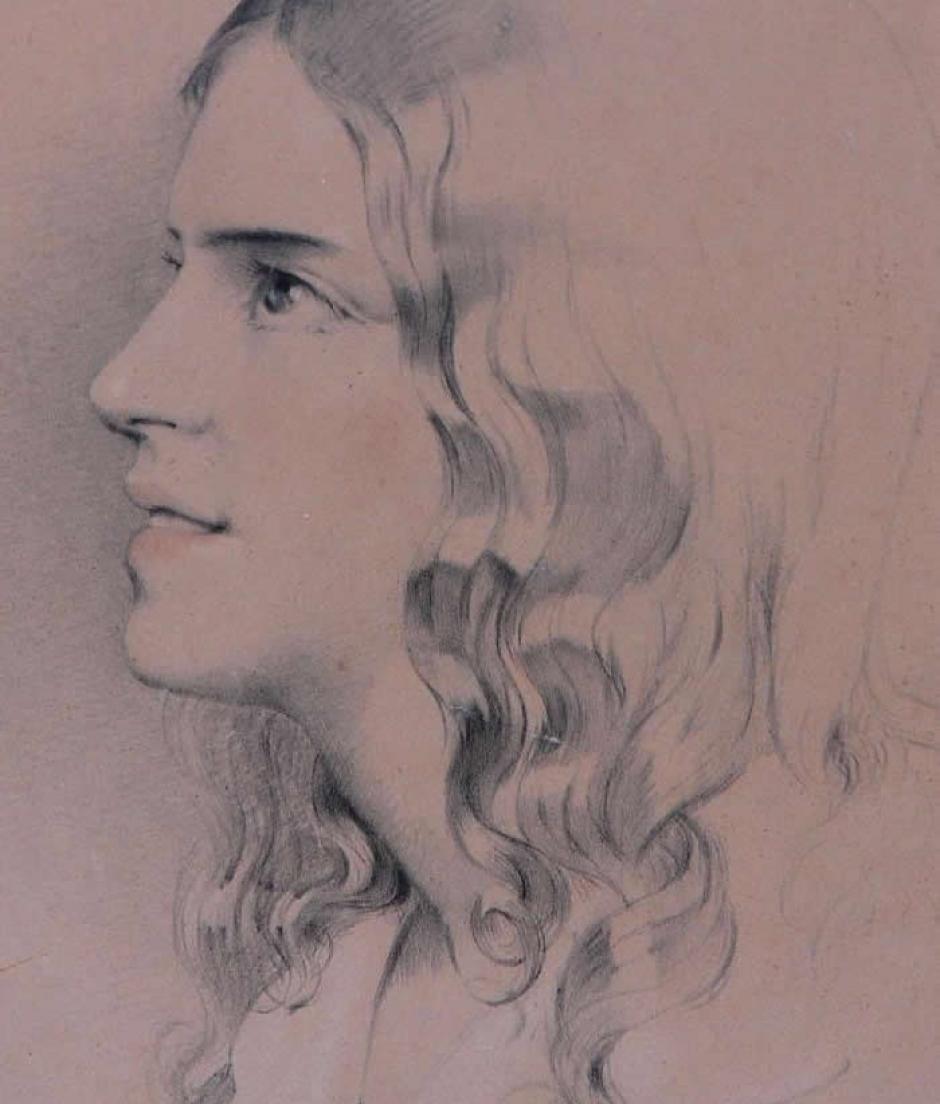
Composer Eliza Flower (1803–46)