
- January 25, 2023
- by John Street (words) and Andi Sapey (photos)
- 8 min. read
Creating Songs of Hope and Protest: A Diary
Or: What happens when you take 400 years of protest songs and an impact budget, and then collaborate with a community theatre group
September–October 2021
When we submitted the proposal of the Our Subversive Voice (OSV) project, we promised to deliver a songwriting workshop. We had only the vaguest sense of what this would involve, save that we’d get together aspiring songwriters with a tutor. We had no real idea how.
While worrying about this, I see a performance of How’s Your Father?, a play staged by a local community theatre group, the Common Lot. The play is based on a study of fatherhood conducted at the School of Social Work at the University of East Anglia and features brilliant songs written by Georgia Philip, one of those responsible for the research. The cast happens to include Duncan Joseph, a former student of mine.
Not only is How’s Your Father? a very moving and highly professional production, it has attracted full houses wherever it has been performed. The Common Lot (CL) might be the answer to our songwriting workshop quandary. I contact Duncan to try out my idea.

'Welcome! We are the Common Lot and we have come to defend your freedom!'
November 2021
I meet Duncan in a pub, and he tells me of the CL’s working practices, and particularly how their musical director, Charlie Caine, is able to create songs and the choirs to sing them, by working in collaboration with diverse local groups. We agree to arrange a meeting with the Director of the CL, Simon Floyd.

Songs of Hope and Protest begins
December 2021
My colleague Alan Finlayson and I meet Simon and Duncan at the CL’s base at the Phoenix Centre in Mile Cross, a particularly deprived area of Norwich. We explain our project and our workshop ‘problem’, and Simon and Duncan talk about the CL and its mission. Its base in Mile Cross is important to the CL’s commitment to the local community, a commitment that has been evident in previous productions by the company.
The idea is for a performance of six songs
Simon, whose enthusiasm and vision is infectious, explains how the CL works, using a combination of research, response and performance. He seems to think that he can turn our research into a ‘show’. The idea is for a performance of six songs (two from OSV’s archive, two written by the CL and two from their past shows).
January 2022
Simon and I meet online. It’s evident that his idea for the collaboration has become more ambitious. There are to be more songs – and more theatrical business. He’s also secured the support of local librarian, Nick Hobbs, who is keen to host the OSV’s mobile exhibition. Nick, it turns out, is another great enthusiast.
Helen Stokes, our multi-talented organiser and creative designer, and I meet Nick at the Mile Cross library (a perfect space, it turns out). He is so positive and helpful, and comes up with the idea of a suggestions letter box. He describes Helen’s plan for a ‘washing line’ display of the background to protest songs as ‘radical bunting’. We confirm the exhibition and a talk to launch it. All we need now is an audience, and the technology required for our Spotify playlist.
Simon secures funding from the National Centre for Writing, based in Norwich, to commission songwriters to work with local community groups.
The number of songs for the performance has now increased from six to ten (five from OSV, three from the songwriting workshop and two from the CL repertoire). So has the number of planned performances – from one to three.
Simon, Charlie, Duncan and Cathy Russell (one of the show’s Assistant Directors) come to a show and exhibition that OSV hosts at the Norwich Arts Centre.
There are more exchanges about the show, which will now include four new songs, five from our project, and only one from the CL repertoire.
February 2022
The OSV team send Simon a list of songs that we think the CL might use in the concerts. Simon gets the Eastern Evening News to cover our collaboration in advance of the first choir rehearsal, for which there is an open call.
I email Simon to wish him luck with the first rehearsal. He replies that they are expecting 15 people. Later he texts to say that 64 turned up! The following week’s rehearsal is cancelled because of an outbreak of Covid.
Alan and I attend the next CL rehearsal. Some 60 people show up. We give a short talk on the project, and then stay for the rehearsal. The choir sing a lusty version of ‘Hanging on the Old Barbed Wire’, and then work on the much more difficult ‘The Gathering of the Unions’. This is arranged as a four-part harmony.
The number of planned concerts has risen from three to eight
To coincide with the exhibition at the Mile Cross Library, Matt Worley, another of the OSV team, Alan and I give a talk about the project in the library. It is a small gathering (but one that is also streamed). It goes well, and, as we’ve begun to find, protest songs are a source of shared interest and enthusiasm. Everyone, it seems, has their favourite which they insist must be on our list.
The call for songwriting commissions has gone out, and we appoint four writers (together with Charlie). The four will work with prisoners, a mental health group, school students and the CL’s women’s group.
The number of planned concerts has risen from three to eight.
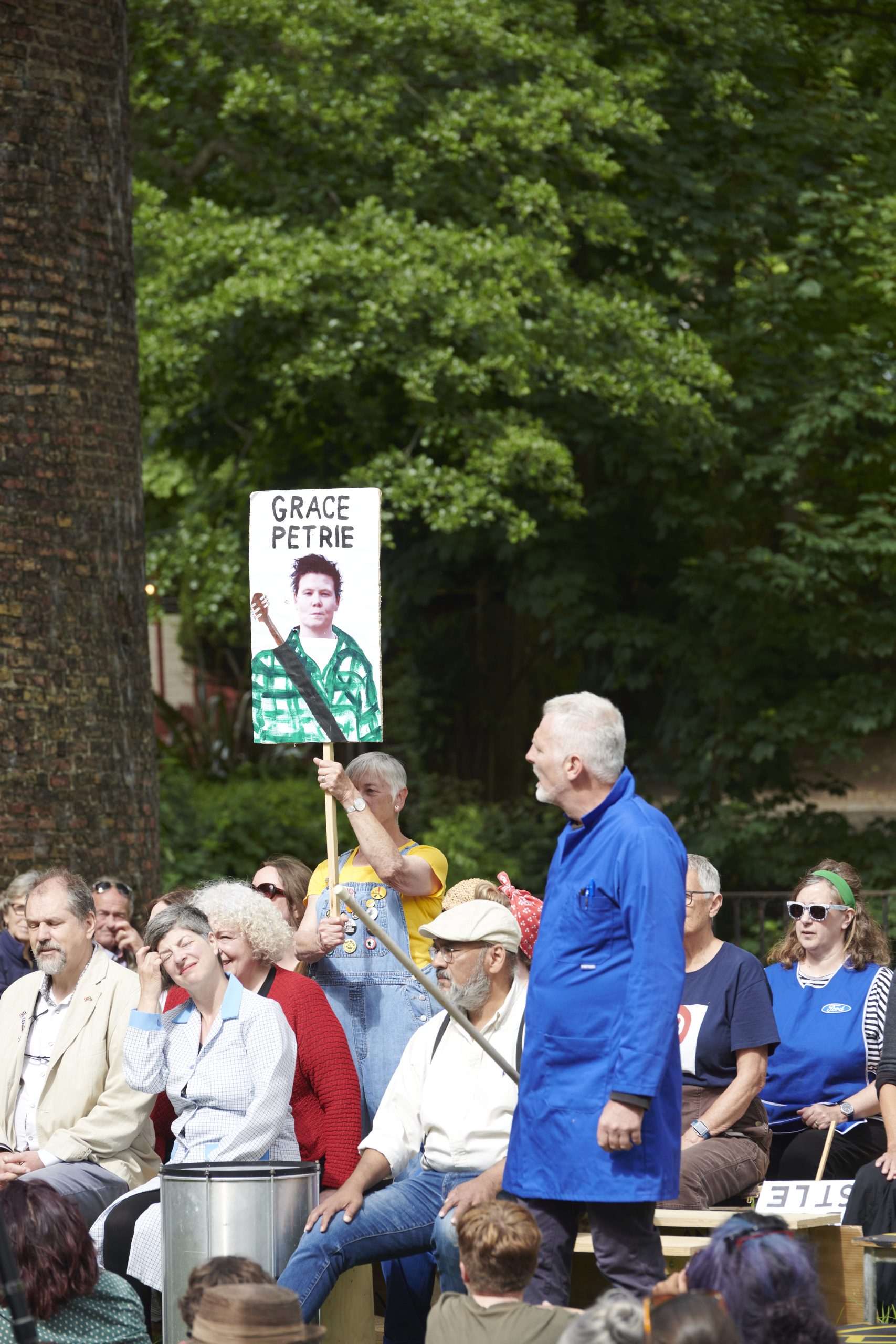
Simon Floyd and the cast
March 2022
Oskar Cox Jensen, our Senior Research Associate, has been making detailed plans for the visit of the BBC to film a rehearsal and to interview Angela McShane and him. He prepares meticulously, making the journalist almost redundant!
The BBC films performances of ‘Hanging on the Old Barbed Wire’ and ‘A Place Called England’, as well the interviews with Oskar and Angela (the piece eventually appears on the BBC website).
Simon produces an impressively detailed and demanding rehearsal schedule for the choir and for the creation of the show. There are now to be six shows in five different venues in June.
While the choir practice new songs, such as ‘There is Power in a Union’, work also starts on the structure and content of the show. The CL split into teams around themes (hope, representation, confrontation, difference), and are asked to come up with a theatrical sketch to illustrate the theme. I am told to ‘float’ between the groups, but get caught up in the discussion by the representation group, and – horror of horrors – I have to perform with the group. This involves speaking and singing. I am traumatised, but I think that the idea we come up with is a good one. My co-performers are brilliant. Never again, I swear.
Another rehearsal. Alan is there too. The highlight is undoubtedly the performance of ‘Liar, Liar’, sung in a circle, with members of the cast stepping into the middle to recount a political lie. There is no shortage of suggestions.
Simon starts work on the script, collaborating with other key members of the CL.
April 2022
Another choir rehearsal. The singers, though down in numbers (there has been a run through of the whole show the day before), are in good voice. They start to learn ‘Glad to be Gay’, for which Charlie has written a new verse.
The OSV team visit the Phoenix Centre to meet Simon and Charlie. Simon is anxious about the script. We run through the current plan, and feed in quotations and background information. Charlie sings the new verses for ‘Glad to be Gay’ and ‘The Man Who Waters the Workers’ Beer’.
May 2022
May Day and the first public airing of five songs from the show. It is held at Cow Tower, near Norwich Cathedral. There are about 12–15 singers and a good-sized audience (the CL has a terrific network of supporters). They sing Charlie’s ‘Song of Protest’ and ‘God Save Great Thomas Paine’, with the CL's John Behm doing a solo for the first verse. For ‘Glad to be Gay’, Charlie takes the lead for the first verse and the new third, while Jayne Clark is given verse two without warning, it seems. They end with ‘Hanging on the Old Barbed Wire’.
There are continuing exchanges over the script. There is a last minute decision to cut the seventeenth-century ‘Parliament Routed’ section. Angela is disappointed, as are we all.
Posters with dates and places arrive. It is happening!
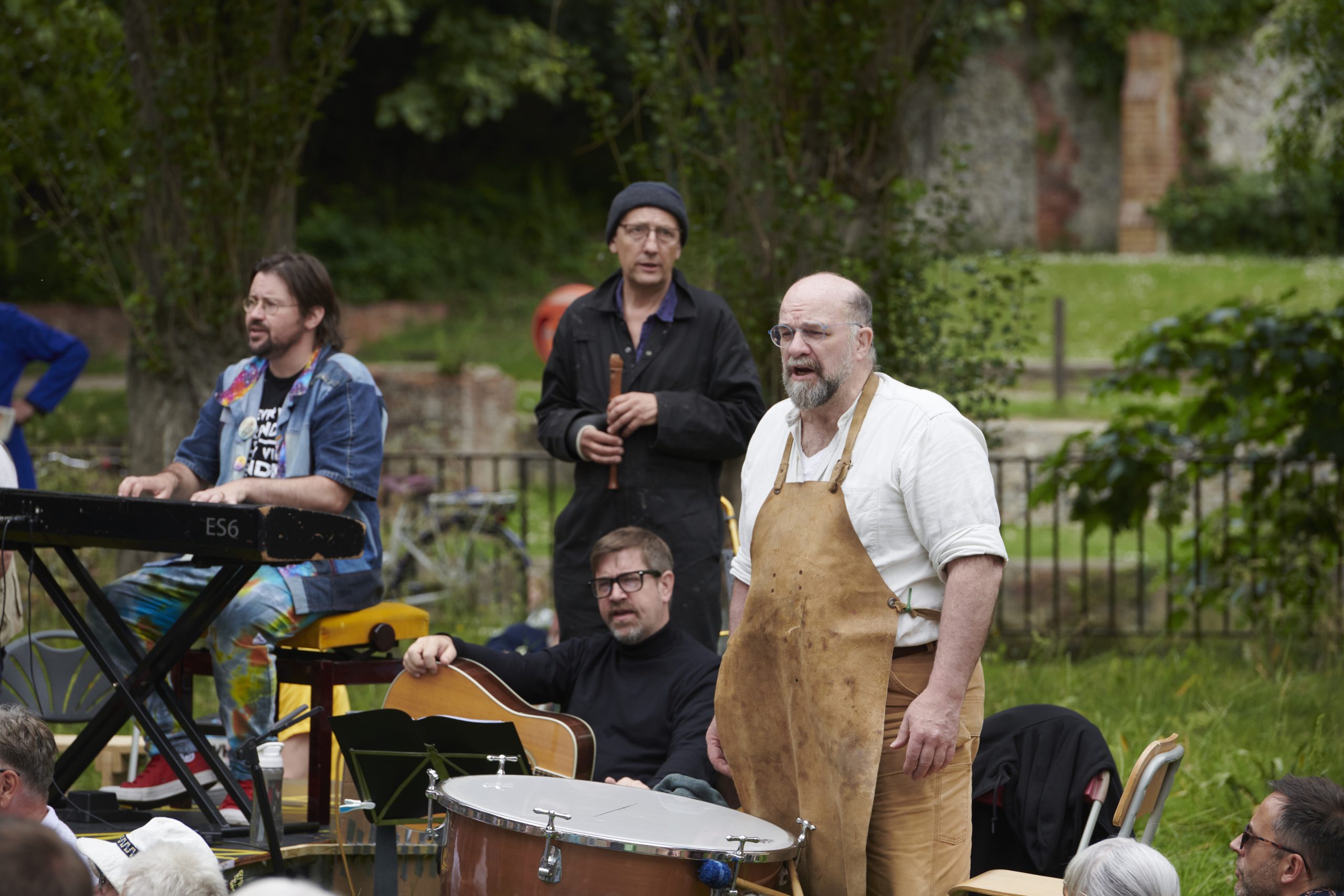
John Behm sings 'God Save Great Tom Paine'
June 2022
I attend the first dress rehearsal. It was to have been in Waterloo Park, one of the venues for the actual show, but moves to the church because of the threat of rain. I arrive to see several ‘suffragettes’ and a couple of World War I ‘soldiers’ outside the church. Almost everyone is in costume. It is clear that a lot has happened in the last few days. There are drummers, a trumpeter, a trombonist (with a broken thumb), a saxophonist, several guitarists, and Charlie on the keyboard. Songs and sequences are rehearsed, and then the dress rehearsal begins.
There are drummers, a trumpeter, a trombonist (with a broken thumb), a saxophonist, several guitarists, and Charlie on the keyboard
The opening is dramatic as a noisy procession enters through the audience (fewer than ten of us for this rehearsal), and then the show is underway. Lines are fluffed and cues missed, but to my ears the singing is good, some sequences make me laugh and others make me cry. The talent and commitment is awesome. Simon, though, is very critical, calling it ‘appalling’. He doesn’t say this to the cast, but he is not happy. The show needs to move more quickly (much less than its current 73 minutes), actors need to speak to the audience (and to learn their lines). He says that the second dress rehearsal in Peterson Park in Mile Cross will be better…
…It is. Still some stumbling over lines, and uncertainty about some of the theatrical business, but the songs are powerful, especially Charlie’s finale ‘Hope in the Dark’. There are laughs too. The show attracts a few passers-by. Simon is much happier.
Simon rings to check the names of the OSV team (we are to act as ‘Stewards’ as well as ‘Academic Advisors’). He is doing the CL programme at the very last moment. He asks whether I don’t like the show. I ask why on earth he thinks this. I say that I’m in complete awe of what he’s achieved.
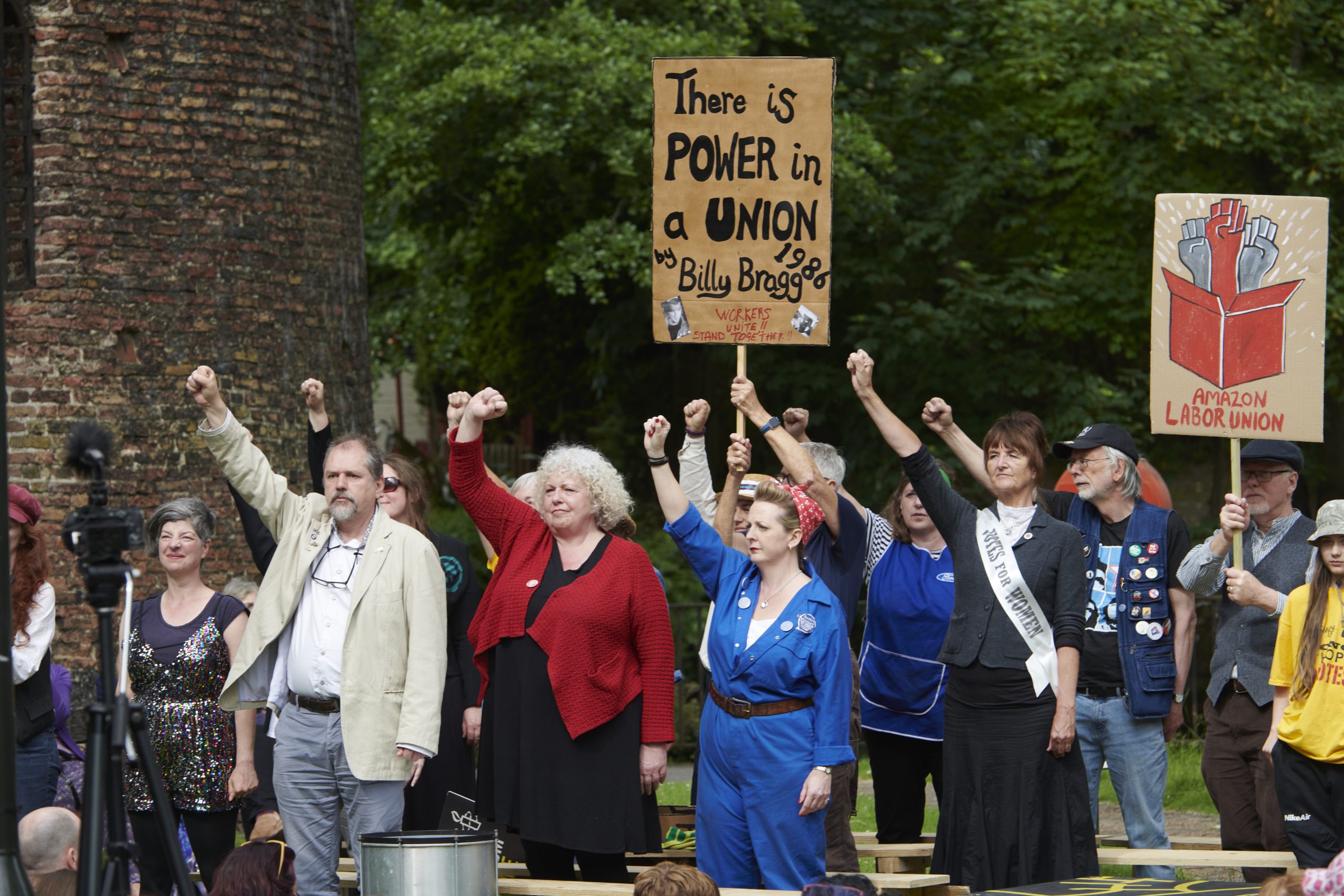
'There is a Power in a Union'
9–12 June 2022
The shows. I am nervous all day before the first night. Helen has done a brilliant job with our booklet, which is given out to all the audience. It is modelled on the songbooks delivered to the Aldermaston marchers by the Broadsheet King. The CL programme is impressive too (Alan, Helen and I, with others, help to fold them before the show). There’s a decent size audience, together with some young cyclists, and mid-way through, a beatboxer. It goes well.
The shows get better and better with each performance. Simon reckons that the second show on the Saturday at Chapelfield Park is the best, but I really like the final one at Cow Tower, with all the OSV team present. Alan makes a guest appearance in ‘Liar, Liar’.
We discover that the show has been performed to over 2,000 people. It earns some lovely comments and reviews online.
There is an aftershow party, of course.
Afterwards
Our vague idea of a songwriting workshop was transformed into the commissioning of songs. ‘Ball Breaker Blues’, written by Georgia Philip and Siobhan O’Connor, featured in the show, as did ‘Song of Protest’ and ‘Hope in the Dark’ by Charlie Caine. Sue Tebble and the Mind the Gap group produced ‘ABCB Free’, which they performed before the show in Chapelfield, Norwich. And Joey Herzfeld worked with inmates at HMP Wayland to create ‘Hope Inside’, which was subsequently recorded.
It is extraordinary how our very vague initial idea has been transformed by the efforts of people who have given up their time and who have invested so much in the show. Not just their efforts, though; their talent too. 30 people are listed as members of the cast; a further 25 form the choir. Then there are the musicians, the stage crew, and everyone involved in the creation of the show. Their imagination, skill and work, under Simon Floyd’s inspirational leadership, is rewarded by audiences who cheer and sing, who share in the protest and in the hope.
For academic researchers, required to plan for and to deliver ‘impact’, this was more fun than research is ever meant to be, and also entirely fortuitous and surprising. It was the product of luck and contingency, as much as plans and strategies. Our experience is, perhaps, an indication that impact can be realised in more than is dreamed of in the dry discourses of the Research Excellence Framework, and that academic research can be both valuable and fun.

The audience at Cow Tower in Norwich