
- March 24, 2022
- by Pam Bishop
- 5 min. read
The Political Song Tradition in Birmingham
A glimpse into the key songs and singers across 250 years of Birmingham radicalism.
The Trad Arts Team is compiling a book of Birmingham songs, drawn from the research of the Birmingham and Midland Folk Centre in the late 1960s and its subsequent activities. Here are some of the songs that demonstrate a healthy political song tradition in Birmingham. I have included some facsimiles, some songs as prepared for the book, and some links to performances.
The 18th Century
John Freeth (1731–1808) was the landlord of a Birmingham tavern/coffee house where many of the radical thinkers of Birmingham met. He published 390 ballads in a series of songbooks called The Political Songster. Some are already featured on the Our Subversive Voice website, for example 'The Old King’s Ghost'.
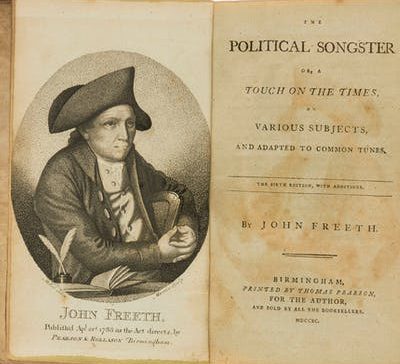
John Freeth’s Political Songster (6th edition, 1790)
The 19th Century
Birmingham was a centre for the broadside press for over 150 years, and 19th-century events in Birmingham gave rise to a number of political songs. The Birmingham Hampden Club promoted parliamentary reform through meetings and petitions, and 'A New song on the Hampden Reformers' was published in 1817 by Sarah Taylor of Moor Street.
'Lady Well' was a spring of soft water near St Martin’s Church in the centre of Birmingham from which carriers delivered cans of water to households for a half-penny each. In July 1818 an attempt was made to enclose the well and place it in private hands – this was successfully resisted. 'The Vain Attempt to take Lady Well' was published by Henry Wadsworth of Moor Street the same year.
Another ballad describing successful action against corruption, 'The Birmingham Rat' was published by William Wright of Moor Street in 1820. This is perhaps a metaphor for various misdeeds by the overseers at the Birmingham workhouse.
Parliamentary reform continued to be a major concern in the city. The Birmingham Political Union founded in 1829 by Thomas Attwood attracted huge support, with rallies on Newhall Hill reaching 200,000 in 1832.

R. K. Dent, 'Gathering of the Unions from Old & New Birmingham'
The meeting was described by Joseph Hunt in his biography of Thomas Attwood. He writes:
The contingent from Bromsgrove arrived rather late, and when it reached Newhall Hill it was greeted by the Union’s Hymn, sung by practically the whole of that vast assembly, for both words and music were familiar at that time throughout the Midlands.
William Wright of Moor Street published the ballad 'Attwood and Scholefield’s Triumph' the same year, and the 'Union Hymn' was printed in an account of the meeting in the Spectator.
In 1839 a Chartist National Convention was held in Birmingham, followed by almost daily demonstrations for which many were punished and two of the leaders imprisoned. On their release, Edward Taylor of Steelhouse Lane published 'A New Song in praise of Wm Lovett and John Collins'. This is described on the Chartists Songs website as a:
specimen of the street melody that prevailed at Birmingham on Saturday last, not as an elegant composition, but as showing the feeling of the people, who soon relieved the ballad-mongers of their stock and set them agog for a fresh supply.
The Corn Laws of 1815 were repealed by Robert Peel in 1846. This was a popular topic for the Birmingham broadside publishers – here’s an example from William Pratt of Digbeth: 'Free Trade, or the Farmers’ Downfall'.
Working class people in the new industrial towns were inspired by the Chartist movement to demand more rights and more pay, leading to a wave of strikes in the later 19th century. Joseph Brueton of Stafford Street published 'Success to the Nine Hours Movement' in 1871.
The 20th Century
The activities of the Birmingham and Midland Folk Centre meant that the tradition of political song in Birmingham in the 20th century was documented to some extent. For example, the Birmingham Clarion Choir, founded in 1940, contributed the triumphant 'Rent Strike Song' from founding member and council tenant Elsie Marshall.
The 1960s was the heyday of folk clubs, including the Folk Centre’s own Grey Cock Folk Club, where political songs were a regular feature.
Bob Cooney, a veteran of hunger marches and the Spanish Civil War, found an audience for his songs there. 'Simply Redeployed' refers to Harold Wilson’s 1966 plans for many working people to change jobs and learn new skills.
Another regular was Don Perrygrove, a car worker and shop steward in Birmingham, who wrote and sang many witty songs. His 'Motor Trade Workers' – written, like the OSV song 'Lock Jaws', to the tune of Charles Dibdin's 1769 'Warwickshire Lad' – was sung at the Grey Cock Folk Club by Graham Langley and Bob Etheridge.

'Motor Trade Workers' – select the image for the full-page song
The Grey Cock Folk Club gave rise to Banner Theatre in the early '70s. Founding member Dave Rogers has been writing political songs for 50 years – a first book of his songs Singing the Changes was published in 2005, and a second is in preparation. Perhaps his best known song is 'Close the Gates', written to commemorate the Battle of Saltley Gate, when the mass picketing by Birmingham trade unionists of a fuel storage depot in Birmingham brought a national miners’ strike to a successful conclusion. Banner Theatre’s YouTube channel includes a performance of 'Close the Gates', as well as many more of Dave’s songs.
The 21st Century
In 2013, the Trad Arts Team set up Sing Political, a monthly pub session, for people to sing and share political songs. After a while the Team began to publish songs in booklets, with illustrations much in the style of the broadside decorative tradition, and taking John Freeth’s title of the Political Songster.
Since lockdown the sessions have been held on Zoom, with songs being uploaded to the Team’s website, going straight out 'onto the street', like the 19th century broadsides. So the tradition of political song in Birmingham continues, bringing us full circle.

Cover of the Trad Arts Team's Political Songster, first issue, March 2014