
- January 4, 2022
- by Keith Negus
- 10 min. read
Protest Songs, Popular Music Studies, and Political Communication: A Dialogue about Categories, History, and Value
The following started as an invitation to Keith Negus (Professor of Musicology, Goldsmiths University of London) to write a blog on his thoughts about the category of the protest song in the OSV project. It has become a dialogue between him and John Street, OSV's Principal Investigator.
Keith Negus: My first question concerns the category of the ‘protest song’ and how it is used to select certain songs and not others. To briefly put the issue in context: Franco Fabbri has written of the various ways that songs are categorised – according to genre, or the requirements of internet search engines, or commercial markets, or culturally specific beliefs. Back in the early part of the twentieth century, Theodor Adorno was critical of 'classificatory thinking’ and argued that it is reductive (collapsing the complexities of a thing into some easily identifiable characteristics), and aspires to an objectivity that conceals the value system it endorses.
John Street: It is certainly true that any attempt to categorise a social phenomenon will be subject to the sort of criticisms you attribute to Fabbri and Adorno. And yet some attempt to narrow the field of study is surely inevitable and necessary. Those definitions are, of course, not innocent of underlying assumptions and agendas, but by making them explicit it opens up a debate about what exactly is being captured by them.
KN: So, by what criteria is something a ‘protest song’?
JS: It is a song that registers disquiet or dissent at the way the world is ordered, but it does more than simply complain. It anticipates or advocates some kind of public response as a means of righting the wrongs that it identifies. This does not mean it contains a fully worked out programme or manifesto, but it is directed at encouraging others to see the problem and to act in some way to address it.
KN: To what category belong all those millions of songs that are excluded: are they simply ‘non-protest songs’?
JS: I think it is fair to say that our working definition of a protest song does mean that those that don’t meet its criteria are ‘non-protest songs’. Clearly a different definition would yield different results. We are certainly not saying that our definition is definitive! What we want to do is to provide a definition that does not confine us to studying only songs that emerge in the US after 1945, and one that highlights the importance of ideas of politics in how we think of song as political communication. And in creating a list of 250 songs we are seeking to highlight the variations in the form across time, but not to say that these are the only ones that matter.
KN: I accept that many ‘protest songs’ will inevitably be excluded. What I’m trying to get at here is the implied category of ‘other’ or ‘non-protest songs’. For example, we could probably agree that a lot of the excluded songs are about love found and love lost, or songs about dancing or growing up. Do you have any reflections on the implied system of classification that the ‘protest song’ is part of, or are you using a straight included/excluded method of selection?
JS: We have been forced to think a great deal about our system of classification. Besides what counts as ‘protest’, we have had to wrestle with what counts as a ‘song’ and as ‘English’. As far as ‘protest’ is concerned, the classification is highly dependent on what is contained in the concept of the political.
The borders of the political are always contested. Indeed, this contestation might seem to define much political activism, from republicanism to feminism and beyond. But we are wary of the idea that ‘everything is political’, if only because it empties politics itself of meaning. We want to expand the conventional definition of ‘political communication’ to include songs that themselves seek to respond to public issues and events. This is necessarily a fuzzy definition, but it does seek to exclude songs that are simply voicing a general or personal complaint at the state of the world.
The borders of the political are always contested. Indeed, this contestation might seem to define much political activism
But it’s important to see what we are doing, not simply as an exercise in classification and listing, but rather as asking how songs come to express or articulate political ideas, and how they try to persuade or mobilise the audience. This involves us in detailed study of the context in which songs emerge and the rhetorical devices that they deploy. We are not offering some general claim about ‘all protest songs’, but rather an approach to understanding how songs are implicated in forms of political protest. To this extent, I don’t see us as saying anything of significance about the songs we don’t discuss. They may well fall within our or others’ definition of a song of protest. That is fine. What matters is how we understand them as communicating politically.
KN: A further issue about categories concerns the historical circumstances that lead to the emergence of concepts, and the words for concepts (an issue discussed in different ways by both Raymond Williams and Quentin Skinner). Is there an issue of historicism or anachronism here, in the use of a particular category from a liberal pluralist ideology that has emerged since the Second World War? Is this leading to the incorporation of songs that may not be understood in this way by other people, now and in the past?
The protest song emerges during the Cold War, and has been used as an illustration of the ‘democratic values’ of the ‘free world’. At the same time, it is an emblem of the rise of cultural Marxism (from Frankfurt School pessimism to New Left optimism) whereby culture is deemed to have significant political effects. So, the question here is: Is it historically accurate to apply the term to such a long history of songs? Are there any allowances for how these songs were described or named in their specific social circumstances?
JS: It is true that the phrase ‘protest song’ or ‘protest singer’ does not seem to be used until after 1945, although there is evidence of a German equivalent being deployed in the nineteenth century. We are conscious of the danger of reading contemporary experience back into past experience. The notion of ‘protest’, let alone the protest song, is indeed a relatively recent idea, and a consequence of changes in political order and structures of power. But this is precisely what drives the narrative of our research. We want to read the history of songs of protest forwards, not backwards, seeing how the use of song – to register contempt for the political class or to draw attention to injustice – changed over time and with changes in the political order.
KN: Could you clarify what you mean by ‘reading the history of songs forwards’. Does this also imply that the text of the song allows us to understand the political structures of the day?
JS: What we are trying to do is to look at how songs of political dissent or criticism have emerged at particular times and in response to particular issues. We are trying to avoid imposing current understandings of the protest song on that history. This isn’t to say that there are not continuities between the past and present – between the objects of dissent (the monarchy, politicians, bosses) or between the agents involved (from publishers to record labels). It is just that we want to see how those continuities emerge through the actions of multiple agents and agencies to give expression to political dissent in song.
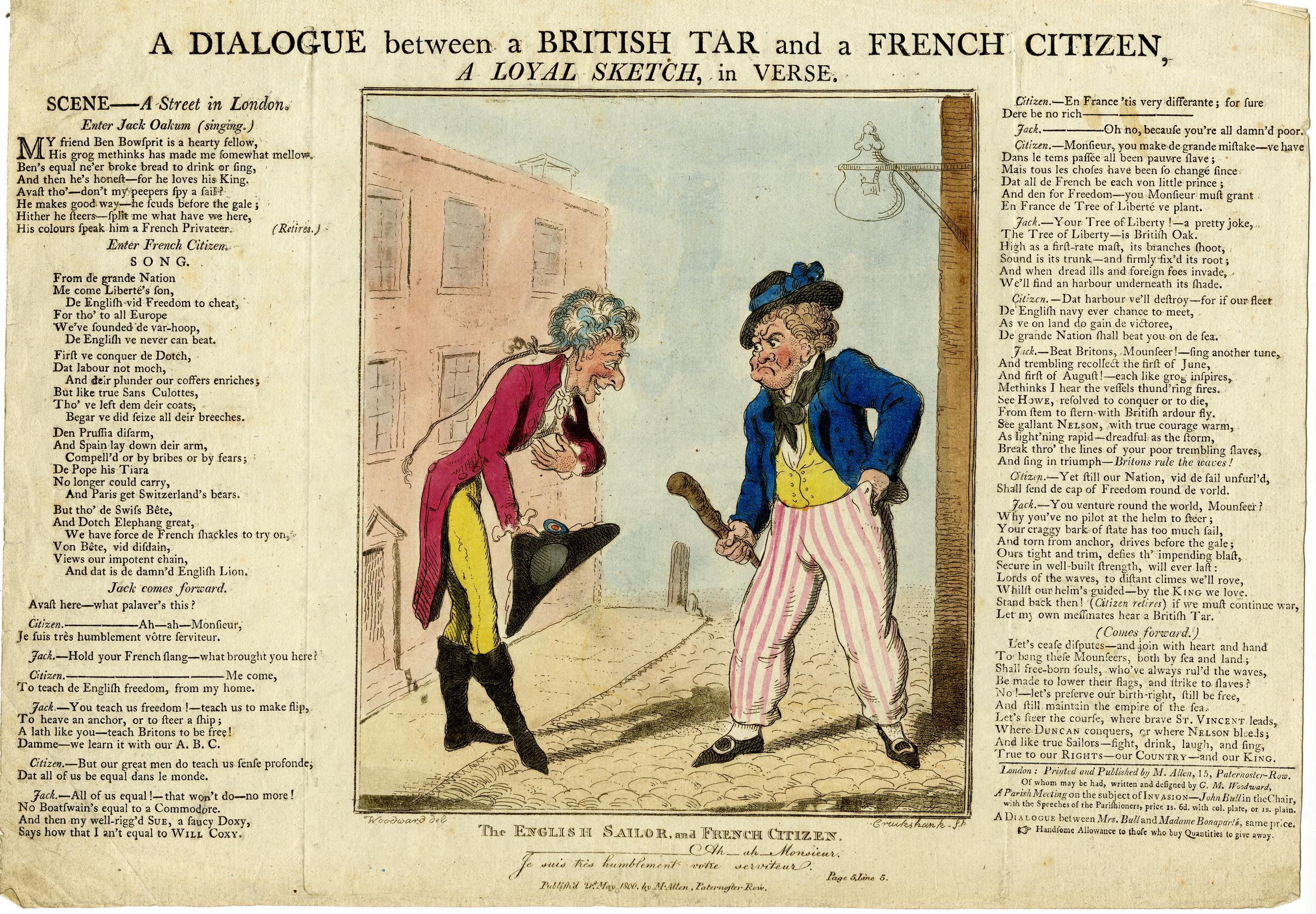
Another artist's impression of this dialogue, 21 May 1800. © The Trustees of the British Museum.
KN: Following up on the previous point is a question about the discourse of value whereby certain types of songs (and composers) are prized for their serious political and social significance whereas other songs are, by implication, merely entertainment or endorsing an implied status quo, or just silly love songs.
The initial development of Popular Music Studies (PMS) as an academic discipline was informed by Marxist assumptions that popular songs can be evaluated according to those that have political value and those that do not. The idea that ordinary, everyday popular culture is and should be political is a prominent strand throughout the history of Marxism, from Leninist and Maoist socialist realist policies to cultural studies orthodoxy that became institutionalised in North Atlantic universities from the 1980s. It is also a strand in the so-called new social movements since the 1960s, with songs valued for their contribution to what has come to be called identity politics.
A focus on the protest song could be located clearly within this Marxist legacy and could be construed as restrictive, programmatic, and potentially exclusionary. Is this a study of propaganda first and the art of the song second, with due acknowledgment of Orwell’s observation, when discussing Charles Dickens, that:
‘all art is propaganda … but not all propaganda is art’?
JS: We – you and I – might want to discuss Orwell’s definition of propaganda, but I’d be inclined to say that some protest songs are indeed propagandist, but not all of them are. I’d also say that not all protest songs conform to the demands of the Left/Marxist orthodoxy. Our long history suggests protest songs can adopt a wide range of political positions. This is not to dispute your account of the development of PMS and its (over)valuing of the political song, but just to say that we try to avoid its pitfalls.
The PMS valuation of the political song has tended to focus on a particular type of song, associated with specific genres (soul, reggae, punk, hip hop etc). Our list includes songs of protest that divert from this norm to include those from the mainstream or classical worlds. Indeed, we would contend that the idea of political song as niche or distinct from the mainstream is a very present-centred one. And if our work has shown us anything, it's the endless porosity of ‘protest’ song relative to the sum total of song culture – generically, formally, musically, it’s in and out of everything, and although there have been clear attempts since, say, the early nineteenth century to focus on a particular sort of song – marches, anthems, hymns – as an organ for politics/protest, the subsequent age of recorded commercial music has exploded that all over again.
It’s true that our approach is a result of taking ‘the cultural turn’ in political sociology, and the recognition that political communication is not confined to the forms and spaces to which politics is traditionally assigned. And in following this approach, our intention is to reveal how the political is musical, and the musical political.
We hope that our study will be of interest to PMS, but it is important for us to reach those who study political history and political communication. Our project is about political song because politics is our focus. At the same time, we are interested in why or how some political songs are more or less able to communicate political ideas or to move people to act politically.
KN: I would dispute the claim that popular music scholars only study protest songs in niche genres, although I accept that there has been a tendency to romanticise protest from what is called the margins. Some of the most significant writing about songs of protest have located these at the centre of major social and political change. I’m thinking here of important writings about protest song in the former USSR/Soviet Bloc, Latin America, South Africa, and East Asia. Is your study informed by arguments and evidence presented in these previous studies, and the claim that protest songs have and can bring about social change?
JS: You are right that there is now a very large literature on songs of protest in many regions of the world, and our research can’t help but reflect the examples and ideas that have emerged from them. It is surprising that, in this context, relatively little has been said about the English variant or has sought to provide the long history of songs of protest.
We ourselves are wary of making claims for the effects that protest songs may or may not have. That would require a project of a different kind. We are interested in how the protest song is produced, performed and circulated; what it seeks to communicate and how it tries to persuade its audience of its cause or concern. It’s more than likely that many or most songs fail in this respect, as do many other forms of political communication. This is in the nature of politics – and the protest song. It does not make the song or politics unimportant.
One of the great strengths of this project will be the way that it moves us away from debates about the 1960s, and introduces a longer historical perspective
KN: The failure of the popular song is a very interesting point to conclude on, particularly in light of how we can now access somewhere in the region of 70 million recorded tracks in the digital archive. Most of these fail on many different criteria, most notably according to judgements about commercial success and critical acclaim – but that’s an issue for another conversation. Adorno remarked (in his book on aesthetics) that it is through its failures that art reveals the limits of existing conditions and points to future possibilities. As with so much of Adorno’s writing this is open to interpretation. But he was much clearer in his criticism of 1960s protest songs, arguing that any attempt to bring together protest with a form of popular entertainment produced by the culture industry for mass consumption as a commodity was doomed to failure from the start (something that Bob Dylan realised almost as soon as he’d been labelled as a protest singer).
One of the great strengths of this project will be the way that it moves us away from debates about the 1960s, and introduces a longer historical perspective on how lyricists, composers, and songwriters have negotiated the demands of commerce, governments, publics, and audiences in attempting to convey a political message. It is also important for those of us interested in narrating longer histories of the popular song; wishing to move away from a narrative that begins in the USA during the post-Second World War period.
Of course, the song forms that are used to register protest in England are imbued with all sorts of influences, from near (Ireland, Scotland, Scandinavia) and from far (India, North Africa), as studies of ballads have shown (not least in the scholarship of Angela McShane). That again is also for another conversation about the ‘Englishness’ of the English protest song. Maybe the study itself will provide a commentary on the issue of national identity, and how it is expressed in song – perhaps by connecting musicology and research on popular song to the formal study of politics. The project promises important insights into the changing historical circumstances whereby songs become understood as a particular type of political communication, and will potentially offer new directions for thinking about politics, protest, and the popular song. I look forward to further dialogues as it progresses.

Keith and John's exchange: an artist's impression from the 17th century. © The Trustees of the British Museum.