
- September 21, 2022
- by Stewart Duncan
- 5 min. read
Bringing Political Song to the Masses: The 1938 Left Song Book
Stewart Duncan gives us a glimpse into the musical strategies of labour activists in interwar England.
In 1938, the composer Alan Bush, poet Randall Swingler, and publisher Victor Gollancz released a collection of songs meant to facilitate broad musical engagement with left-wing causes in England. As a compendium of the movement’s most accessible music, the Left Song Book (LSB) showcases the diverse forces powering progressive musical action in the 1930s.
The Left Song Book’s Origins and Context
Song books had long been a part of political outreach in England. In the late nineteenth century, the Victorian belief in music’s moral power, the amateur singing craze, and the rise of new forms of leisure and associational life encouraged labour groups to use music to expand and empower its support. Novel approaches emerged in the form of Labour 'churches' and socialist 'Sunday Schools' that combined moral and political messages with community singing. Song books functioned in these contexts much like hymnals, providing participants with a common cultural fabric.
young and bearded and terribly energetic
In the interwar period, labour movements increasingly used choral singing as a tool for concrete political action. In neighbourhood choirs, marches and protests, mass spectacles and pageants, festivals, educational programs, and more, choral music was a visible (and audible) component of progressive political work. The Labour Party, for example, used local choirs and musical events to support what Matthew Worley calls the 'hard doorstep work' of getting out and 'explaining the Labour Party’s relevance' to the electorate.5Matthew Worley, 'The Fruits on the Tree: Labour’s Constituency Parties between the Wars', in The Foundations of the British Labour Party: Identities, Cultures and Perspectives, 1900-39, ed. Matthew Worley (Farnham: Ashgate, 2009), 202. Socialist and Communist organisations used singing to empower and educate their working class constituents. By the 1930s, musical activities were used across the broad labour spectrum to amplify the movement’s greatest concerns, including anti-capitalist and anti-fascist protests.
In this environment, Bush, Swingler, and Gollancz intended the Left Song Book to provide the labour movement with an accessible and effective musical repertoire. Bush was at the center of nearly every progressive musical activity of note in London in the 1930s; the Daily Herald described him in 1937 as 'young and bearded and terribly energetic' and 'the driving force in this movement.'6Stuart Fletcher, 'Nine Composers—One Tune', Daily Herald, 9 April 1937, 19. Bush’s Workers’ Music Association, established in 1936, published choral music, trained new conductors and singers, and organized performances by Labour and socialist choirs. Swingler was a frequent collaborator for Bush’s own political music. Gollancz ran the expansive Left Book Club network, which provided progressive reading and recreation to 57,000 members at its height in 1939.7Roger van Zwanenberg, 'The Origins of the Left Book Club', Pluto Press: Independent Radical Publishing, accessed November 9, 2020. By the end of the decade, the Club had formed a number of specialty groups and influenced efforts to form a Popular Front movement in Britain.8Stuart Samuels, 'The Left Book Club', Journal of Contemporary History 1, no. 2 (April 1966): 67.
The Left Song Book’s Contents
The LSB’s repertoire reflected the collaborative hopes of the interwar left by emphasising themes of broad socialist unity and international solidarity. Bush and Swingler included twenty-five songs in four categories, incorporating old and new left-wing music from both domestic and international movements. They asserted that this 'wide range of songs' would allow choirs to 'sing what we really mean.'11Alan Bush and Randall Swingler, The Left Song Book, 1938, Frederick Warner Papers, A.63, University of Essex. They also took great care to emphasise the book’s practical value: “[the LSB] aims to do no more than provide a repertoire of songs which can be of use on any occasion…at which people united by a common determination to work for the sane society of socialism, may feel the impulse to utter their unity of purpose in the traditional way of singing.”12Ibid.
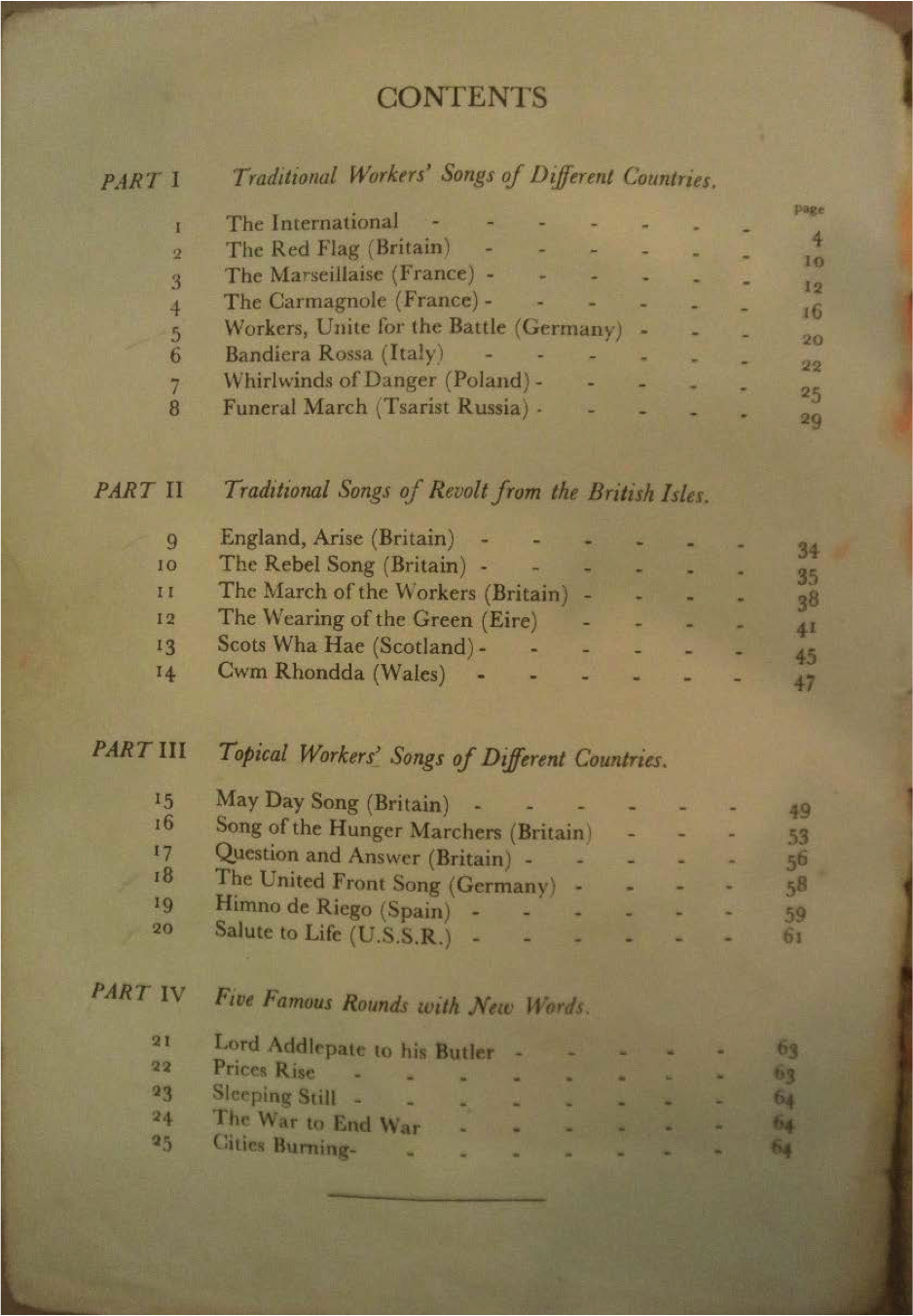
Contents Page of the Left Song Book (select to expand)
A major aspect of the LSB’s value was its musical accessibility. Interwar labour choirs were often hampered by repertoire that was too difficult, too extreme in its views, or simply unenjoyable to sing. Bush directly addressed these concerns by including music that could be sung 'either in unison with piano accompaniment or in parts for mixed voices with or without accompaniment'.15Ibid. He pointed out that 'even the part arrangements are easy to learn, and when sung in unison most of the tunes can be picked up very quickly'. Additionally, every piece in the anthology was set in both traditional staff and tonic sol-fa notation. While this produced cramped scores, it kept the music accessible. By focusing on practical barriers to performance, Bush and Swingler departed from earlier socialist efforts to expose working-class singers to difficult – but edifying – music of the 'highest class'.
The book’s first and second parts focused on traditional songs from global and British movements respectively. Many of these, such as 'The Internationale', 'The Red Flag', and the 'Marseillaise', were still in active use by interwar singers despite their age.16Wal Hannington, Unemployed Struggle, 1919–1936: My Life and Struggles amongst the Unemployed (London: Lawrence and Wishart, 1936), 64–5, quoted in Duncan Hall, 'A Pleasant Change from Politics': Music and the British Labour Movement Between the Wars (Cheltenham: New Clarion Press, 2001), 101. Part II included songs from around Britain, such as a setting of new words to the patriotic Scottish song 'Scots wha’ hae'.
Footage of the 1934 Hunger Marchers
Part III focused on recent approaches to labour song. Nancy Head added new words to Shostakovich’s 'Song of the Counterplan', the popular and jaunty main theme from the 1932 Soviet film Vstrechnyi, to create 'Salute to Life'.19Dmitri Shostakovich and Nancy Head, 'Salute to Life', Workers’ Music Association, 1939, Frederick Warner Papers, A.66, University of Essex. For more on 'Song of the Counterplan' and Shostakovich’s reception on the British Left, see John Riley, 'From the Factory to the Fiat: Thirty Years of the Song of the Counterplan', in Soviet Music under Lenin and Stalin: The Baton and Sickle, ed. Neil Edmunds (London: Routledge Curzon, 2004), 67–80, and Pauline Fairclough, 'The "Old Shostakovich": Reception in the British Press', Music and Letters 88, no. 2 (May 1, 2007): 266–96. Several agitational works by Bush, modelled on the music of German emigre composer Hanns Eisler, were included in this section. Bush’s 1931 unison anthem 'Question and Answer' urged the audience to respond directly to questions describing capitalist exploitation (Choir: 'Are the workers badly fed?' Audience: 'Yes! Most of 'em').20Maria Kiladi, 'The London Labour Choral Union, 1924-1940: A Musical Institution of the Left' (Ph.D. thesis, London, Royal Holloway, University of London, 2016), 61. Bush’s 1934 'Song of the Hunger Marchers' captured opposition to the 'Means Test' introduced by the National Government in 1931 by calling for the chorus represent stamping and shouting marchers.
'Song of the Hunger Marchers'
In Part IV, Swingler provided new words to five familiar rounds. He converted 'Three Blind Mice', for example, into a commentary on economic pressure:
Prices rise, prices rise,
See how they mount, see how they mount,
They’ve raised the price of your daily bread,
And given you cruisers and guns instead,
For they know it won’t trouble you when you’re dead
That prices rise.22'Five Famous Rounds with New Words', Worker’s Music Association, n.d., Frederick Warner Papers, A.69, University of Essex.
This final section gave the LSB yet another musical connection to current progressive concerns.
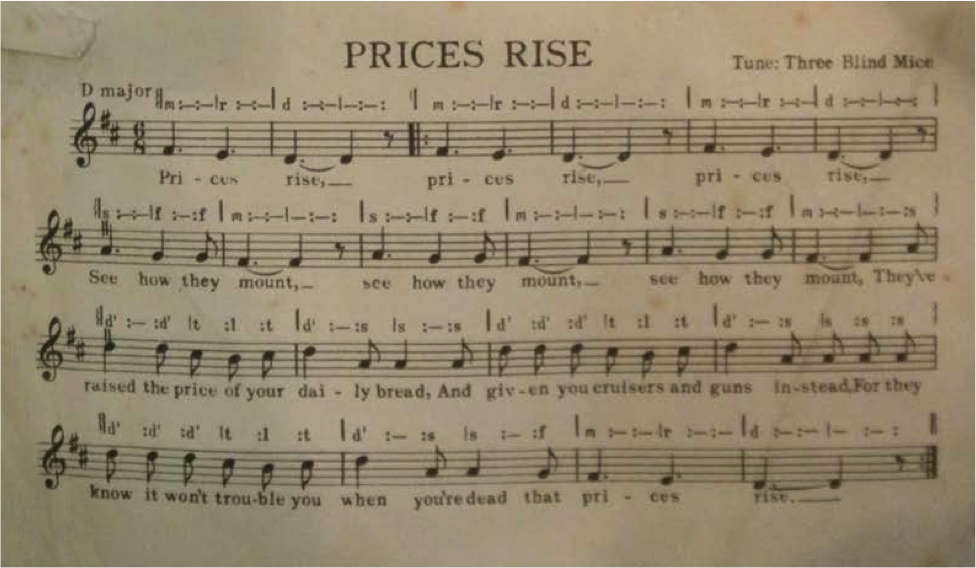
'Prices Rise'
The Left Song Book’s Influence
Thus while The Left Song Book acknowledged socialist musical traditions, it also reflected Bush and Swingler’s vision for a more agitational and politically influential choral repertoire. The modes of performance required by the WMA’s new literature were uncommon in the music of the labour movement before the interwar period; there is no doubt that Bush and Swingler hoped to make them more common by including these works in a publication set to be distributed so widely.