
- December 15, 2021
- by John Street
- 9 min. read
The Critics’ Group and the Singers’ Club: Intermediaries in Action
A delve into the archives of two legendary venues for protest song between the 1950s and ’90s
Our case study on intermediaries and the protest song drew attention to the many actors and agencies that enabled the music to be created, performed, recorded/published and heard. Little was said about the details of these relationships, and how political parties, movements, theatre groups, trade unions etc. actually facilitated the making of protest music. This case study furnishes some of this detail by concentrating primarily on the role played by the Singers’ Club and the Critics’ Group. Both of these were run by Ewan MacColl and Peggy Seeger, leading figures in the English folk revival of the 1950s and 1960s, and major contributors to the repertoire of protest songs in circulation.
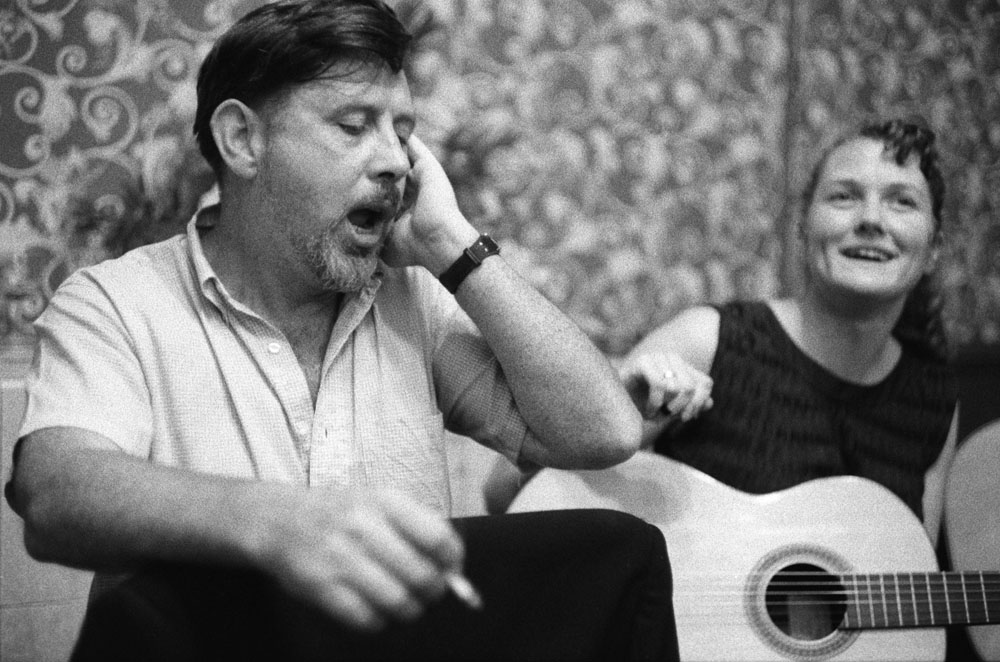
Ewan McColl and Peggy Seeger at the Singers' Club, London, 1962. Credit: Brian Shuel
The Critics’ Group met between 1964 and 1971, and existed primarily to develop and share skills in song writing, particularly political songs. The Singers’ Club, which began life in 1953 and lasted until at least 1991, provided a venue for performing and hearing folk music, not all of which was political. The two organisations were closely linked, not just by the presence of Seeger and MacColl, but also by their shared membership and their reliance on the London Cooperative Society Education Committee for sponsorship.
The Singers’ Club
The Singers’ Club was dedicated to the performance of songs, rather than helping to write them. It was based in London, and MacColl was a regular performer. It had begun life as the Ballad and Blues Club in High Holborn in 1953.
The Club, under MacColl’s leadership, became committed to perpetuating a particular style of folk music, setting standards for its performance. This meant establishing what it was not, as much as what it was; that is, not about songs sung by ‘failed pop singers, navel contemplators, or professional alcoholics’.10The Lark, January 1980. MacColl was dismissive too of ‘electric folk’ (as played by bands like Fairport Convention).11Quoted by Karl Dallas in ‘Acoustic is Best’, Melody Maker [n.d.] Later, Seeger explained the more positive side of the Club’s policy:
This policy was meant for OUR club, not for other clubs. The policy was simple: If you were singing from the stage, you sang in a language that you could speak and understand. It didn't matter what you sang in the shower, at parties, while you were ironing or making love. But on stage in The Ballads and Blues Folk Club, you were a representative of a culture – you were interpreting a song that had been created within certain social and artistic parameters. Incidentally, along with this policy came the request from our newly-formed Audience Committee that we not sing the same traditional song more than once every three months … they were getting tired of hearing the same songs week after week. This forced us residents to learn new songs at an unholy rate. But it brought out lots of new songs and ballads and really got us thinking about how we sang what we were learning.12Seeger, Peggy ‘Ewan MacColl Controversy'.
Although the policy adopted by the Club seems interested only in matters of style and aesthetics, there was also a political agenda, which was present throughout its existence.
In 1983, the Club Minutes record:
Peggy sees the maintenance of the club as an aesthetic/political task.13Minutes, 8 November 1983
A few years earlier, The Lark, the Club’s newsletter, responded to the claim by a disgruntled member that the Club was 'bigoted, politically motivated and elitist'14The Lark, January 1980. They were not alone in complaining. The archives contain a letter (17 November 1976) complaining at the political content of an Anti-Apartheid concert organised by MacColl and Seeger. The editor, Jim Carroll, wrote:
The accusation that we are politically biased is one that most of us in the club would happily plead guilty to.
This was a consistent line. Back in 1967, Singers’ Club News (The Lark’s predecessor) announced:
Because we don’t believe in napalm democracy, we folk singers want to speak up alongside millions of other people who support the rights of the Vietnamese to settle their own future … Songs may not be as lethal as bombs – but they make less mess, and they only hit those they are aimed at.15Singers’ Club News, No 7, January 1967.
The evidence for the Club’s politics is contained in the many songs that were written specially for the evening’s entertainment. Almost all of these are political. The archives contain songs attacking almost every prime minister from the Club’s inception to its closure, from Macmillan to Major. Other examples include: MacColl’s ‘Rogues’ Gallery’, sung to the tune of ‘Oh Dear, What Can The Matter Be?’ –
They’ve privatised oil and the telephone system
Gas and Rolls Royce, it takes too long to list ’em …
Oh dear, got to get rid of ’em
– and Seeger’s ‘House Wife’s Alphabet’ (‘A is for altar where we go astray’).
While these political views were shared by many members of the Club, it is clear that they owed a great deal to Ewan MacColl – as did the prescribed musical conventions. And the latter were not always welcomed. Rob Young reports that ‘a doctrinaire atmosphere reigned’, and that MacColl was
accused of encouraging parochialism by insisting on musicians confining their repertoire to their own place of origin.16Young, Rob (2010) Electric Eden: Unearthing Britain’s Visionary Music, London: Faber and Faber, pp. 144–6.
Despite these tensions the Singers’ Club survived, in one form or another, for nearly forty years. It was a hand-to-mouth existence, though. There was a seemingly endless struggle to attract an audience (in 1988 the average attendance was 56). One response was to review the performers being booked:
Guest singers will, in future, be graded according to their attraction and ability and an appropriate increase on entrance tickets.17Minutes, 12 December 1973.
Another was to revisit the advertising strategy – the regular adverts in the Morning Star are reported to have had little or no effect. There was also a struggle to find a suitable pub in which to hold the concerts, as well as to cover costs. Singers were paid £14 for each performance in the 1980s, and the Club resorted to selling t-shirts, mugs and badges to supplement the entrance fee of 40–50 pence.18Minutes, 4 March 1988. The Club was eventually wound up on 6 December 1991.
The Critics’ Group
The Critics’ Group was born of the Singers’ Club and of the request by some of the performers to learn better how to sing folk music. The Group met weekly in MacColl and Seeger’s home in Beckenham. It was, in Seeger’s words, a ‘study group’, designed to celebrate the songs of the working class.20Seeger, 2017, p.259, p.258. From its beginnings the Critics’ Group was closely associated with political causes, particularly the Vietnam War. The Group was, for instance, directly involved in founding ‘The Folksingers’ Committee for Peace in Vietnam’ to coordinate opposition in the folk scene to the war. But this was by no means the only cause that they adopted. Among other things, they campaigned for the rights of travellers and women’s equality, and against nuclear war and nuclear power. Each winter from 1965 to 1971 they staged the Festival of Fools, a satirical look back at the past year.
Membership of the Group varied, but the archives at Ruskin College list these participants:
John Andrews, Frankie Armstrong, Rex Benjamin, Bob Blair, Brian Byrne, Jim Carroll, Phil Colclough, Pat Creedy, John Faulkner, Luke Kelly, Donniel Kennedy, Floyd Kennedy, Sandra Kerr, Pat Mackenzie, Jim O'Connor, Roy Palmer, Charles Parker, Brian Pearson, Jimmy Ross, Irwin Silber, Dick Snell, Denis Turner, Jack Warshaw and Terry Yarnell.
Many of these were singers or musicians (Luke Kelly was to become a member of the Dubliners), but Charles Parker was the leading light behind the BBC Radio Ballads series, to which Seeger and MacColl contributed, and which resulted in some of the songs that appear on our 750 list (such as ‘Grey October’ and ‘Moving On Song’). Roy Palmer was responsible for several books documenting the history of song in England and its links to social and political change. Irwin Silber was the editor of the leading folk magazine, Sing Out!.
Others did not see it quite this way. They describe Ewan MacColl as dictating both the style and the content of the songs to be written. Young252010, p. 189 and pp. 144–6. writes of ‘the spartan industrial dogma of the Ewan MacColl circle’ and of ‘[t]he dictatorial view of MacColl’. In a New York Times article, Robert Shelton characterises MacColl as the ‘Charles de Gaulle of the British Folk Revival’ with his ‘steel-grip [a]esthetic’.26Shelton, Robert (1966) ‘Britain’s Folk Scene: “Skiffel Craze to Clubs in Pubs’, New York Times, 6 March. Vic Gammon wrote of MacColl and Seeger’s ‘puritan isolation’.27Ruskin Archives, n.d. In a BBC documentary about the Group, Richard Snell says of MacColl that ‘he was a Stalinist’. And indeed, the programme contains a recording of MacColl ending one meeting with these words:
Can I have at least three songs on Vietnam for next week’s meeting?
He offered to write one himself, but added ‘though, God knows, I’m busy enough’.28BBC (2012) ‘How folk songs should be sung’, Radio 4, 3 January 2012.
Peggy Seeger, who was, of course, not impartial, paints a different picture. She acknowledges that ‘Ewan wanted to teach and didn’t much care if he was liked or not’32Seeger, 2017, p. 258. and that ‘Ewan fervently believed that art and democracy are not compatible.’33Ibid., p. 272. But in an interview in Sing Out!, she credits the Group with teaching her how to write songs. The fact that they were political songs, she suggests, is just a feature of who attended:
because a number of members of the group were involved politically … we decided to write songs about given subjects.34Garrison, L. and Plant, S. (n.d.) ‘Honing, Polishing, Casting Out: Peggy Seeger Talks about the Folk Process’, Sing Out!
She also notes, in this same interview, that the journey from politics to song is not straightforward:
Political groups I find are, on the whole, very philistine as far as regards songs. They often want slogans set to music.
But then, in a telling anecdote in the Sing Out! interview, she describes how she came to write ‘I’m Gonna Be An Engineer’:
I did not write that because I had any tremendous feelings about the women’s movement at the time. I was working with a group that was doing a political show [Festival of Fools] every year. Ewan MacColl ran it and it was called the Critics’ Group. Every year we gave a resumé of the news, and in 1970 there was a lot of attention being given to the women’s movement. Ewan, who usually did the writing, said, ‘Look, I just haven’t got time to write this. And anyway, you should write it’ … Ewan said, ‘we’ve got to have that song and we’ve got to have it in a week’.37Garrison and Plant, n.d.
In her memoir, where she acknowledges that MacColl had asked her to write ‘a women’s song’ for the Festival of Fools, she says:
‘I’m Gonna Be an Engineer’ was one of those songs that just appear. Standing unbeknownst on the threshold of feminism and never having wanted to be an engineer, I wrote it in two hours and took it upstairs to Ewan’s cubicle in the cistern room. He was brisk. The last verse is depressing, Peg. You need some hope. Downstairs again, rewrote the verse, Mabel’s Your Auntie and back to doing the accounts.38(Seeger, 2017, pp. 265–6; italics in the original.
These stories are revealing of MacColl’s role in the Critics’ Group, but also of the contingencies that connect songs with politics – and perhaps of the limits to historical research into the business of songwriting!
Much of this information is to be found in the Ewan MacColl and Peggy Seeger archives in Ruskin College Library. All references to the ‘minutes’ are to be found there. Our thanks are owed to Raymond King for his help with finding this material.

Bob Dylan at the Singers' Club Christmas party, London, 1962 on his first visit to Britain. Credit: Brian Shuel, who adds that: 'Ewan [MacColl] made [Dylan] audition, would you believe, a week earlier! Subsequently Ewan devoted all his waking hours denouncing Dylan for ripping off Woody Guthrie. Incidentally Ewan appears on the right edge of the picture (and Bert Lloyd behind Dylan's head). It is probably the only picture in the world with both of them in it!'