
- November 8, 2021
- by Oskar Cox Jensen
- 16 min. read
Lessons from the 750
A dive into our intentions, methods, and preliminary findings – the best place to begin a deeper exploration of our topic
As at once a public-facing and scholarly project concerned with more-or-less popular song, a big list was always going to be a part of OSV. This draws inspiration from, on the one hand, curatorial and academic projects (Neil MacGregor’s History of the World in 100 Objects; co-I Angela McShane and Chris Marsh’s 100 Ballads: Hit Songs and their Significance in Seventeenth-Century England) and, on the other, the music business and music journalism – which tends to add an often spurious hierarchy (the Billboard 100 or UK top 40; the list culture of NME, Pitchfork or Kerrang satirised in Nick Hornby’s twice-adapted High Fidelity).
OSV is concerned with the longue durée of protest song in England: 1600–2020. 420 is a lot of years to cover, and our modest aim was for 250 songs, chosen above all for the sake of their interest – what each of them offers to a close reading/listening. It soon became clear that this would involve a lot of choosing, especially when we picked a hundred out of the air within a single day of starting. Besides the project’s own research, this has involved consulting with 55 experts in various periods and traditions – and even though our criteria for inclusion have been pretty exacting, we had far more than 250, hence a ‘reserve list’ of another 500 songs.
Though 250 and 750 are both numbers, they are essentially arbitrary numbers, and nothing about this process has been ‘scientific’, statistical, objective, or controlled: it is important to state at once that this list was never meant to be, nor ever could be truly representative. This is partly due to our sources: what is extant is partial, ephemeral, and what has survived has often done so due to the whim of eccentric collectors or interested political actors. Conversely, many of the most provocative protest songs may well have been censored out of existence. And above all, we are working with records, which are overwhelmingly textual or recorded, in an area where many important songs – topical, controversial, even improvised – may have remained solely in the fugitive realm of tongue, ear, and air. Partly, it is due to our process: we have been guided by our predispositions, our existing expertise, our familiarity with certain archives, institutions, periods, people. Though we have tried to check, to broaden, to counter-balance, to second-guess, this is necessarily a fallible and subjective endeavour.
The 750 is a sort of salmagundi, a riot ... The 250 has been carefully curated
It should be said that, when choosing the 250 from the 750, we have at least sought to redress – within reason – the massive chronological disparities that have overpopulated certain periods of the 750. This is not a purely telescopic imbalance: while the 21st century and 1980s are hugely overrepresented in the 750, so too are the 1790s and 1810s, while the 17th century has far richer pickings than the 18th century before 1789, and the period of 1918–1945 is perhaps the leanest of all.
To clarify, this is how the lists should be read: the 750 is a sort of salmagundi, a miscellaneous riot of songs, unregulated, jostling, there to pique the interest of those willing to explore. The 250 has been carefully curated: it is an artful rather than scientific list, that seeks to do justice to the full span of 420 years and the subjects of protest over that time, picking the most fruitful songs rather than necessarily the most successful (in terms of either impact or aesthetics).
Our criteria for selection (see other case studies) has also led to some notable absences as well as inclusions. It also lays us open to accusations of tokenism in including a mere handful of reactionary, nationalist, or far-right protest songs – though we might argue that, so far as we can tell, these have always been exceptional in the historical record (as opposed to non-protest songs seeking to reinforce the status quo or written from a position of political power, for example, which have been legion). We have occasionally broken our own criteria when it comes to ‘Englishness’, especially on the 750 (see the relevant case study) – but only where a Welsh, Scottish, Irish, French, German, or American song (not such a long list of alternative origins) has been significantly reinterpreted or reappropriated within a specifically English tradition of protest, or even written or translated in England – as with the Marseillaise, ‘The Red Flag’, or ‘The Land Song’.
Lessons from the process
Reflecting upon the research methodology that led to these selections, it is worth considering the role of ‘the archive’ and the known historical record. Extrapolating from our methods, these 420 years may be divided into two clear periods, that cleave in the later eighteenth century. (This is excepting those standout, famous songs from all periods, which have resounded so loudly that we have headed straight for them without the need to search). Before the late eighteenth century, we have located songs primarily by sifting larger collections that are constituted on the basis of the medium – primarily cheap print archives such as EBBA and the Bodleian Ballads collection, and secondary repositories such as the British Museum, published collections of Jacobite songs, and our own Angela McShane’s bibliography of 17th-century political songs.
After that date, the process has been significantly less anonymous: whilst we have continued to employ the earlier method (even into the very recent past via repositories such as Antiwar Songs or collections devoted to miners’ or Greenham Common songs), the bulk of our material has been led by individual songwriters. Rather than minesweeping mostly unauthored archives, we have identified numerous ‘likely’ songwriters, and delved into their collected works or back catalogue. This starts with the Birmingham publican John Freeth, who began publishing his own collections in the early 1770s.
From this point onwards, this has proved extremely profitable – supplemented for much of the mid-19th to mid-20th centuries with the collections of movements: the Chartist National Hymnbook, Edward Carpenter’s Chants of Labour, the albums of the People’s Liberation Movement, and so on. In many cases, individuals (or groups) have self-published; in others, we have editors to thank. The roll call of names is illustrious and instructive – to name but a few, Edward Rushton, James Montgomery, Samuel Bamford, Eliza Flower, Ebenezer Elliott, Thomas Cooper, Eliza Cook, Ned Corvan, William Morris, Edith Nesbit, Ethel Smyth, Ewan MacColl, Lord Kitchener, and any number of living artists – all cases where the writer’s reputation has been the beacon, and the individual songs only then extracted, bright as burning coals.
This chronological shift says much, we believe, about a fundamental change in publishing, the public sphere, public opinion, censorship – in short, that entangled realm in which, at some point, it became not only possible but advantageous for a writer to lay claim publicly to a body of work. The fact that, in our list, this phenomenon begins with a publican, already famed for performing his songs in his own public house, may be no more than a coincidence – but we would prefer to think that it speaks to a real historical truth about the changing status, interest in, and danger of protest in England. (Of course, a large number of these writers were imprisoned as a result of their activities well into the nineteenth century: they proudly tell us so in many songs, subtitled, ‘Written in such and such a gaol’!)
Lessons from the songwriters
When ‘tagging’ all these songs, and especially in light of the prominent role played by renowned songwriters in determining our selection, we felt it important to document the generic identities and origins of the songs’ creators wherever known – a process that presented us with some numbingly predictable findings. Geographically, the bulk of our songs across the period stem from London, the centre of the music and publishing industries in all their iterations, with strong showings from the urban centres of the midlands and the North. While we have isolated rural songs from across the country, the south-west and East scarcely feature – though each can claim an outstanding protest song in ‘Trelawny’ and ‘The Powte’s Complainte’, respectively.
In terms of composition, the default mode of songwriting until the 1950s has been that of contrafactum – selecting a well-known pre-existing tune, and giving it new words – though some songs specify no tune, and the nineteenth century sees the first significant wave of original musical composition, along with the more high-brow practice of creating a song by setting pre-existing verse to music. All of this broadly accords with what we know of song culture as a whole – though there are perhaps more instances of direct parody, where the choice of tune serves an explicit political purpose, than is the case in other areas of songwriting.
Meanwhile, and despite our best efforts, we have been unable to positively identify a protest song written by a woman before the nineteenth century, by a person identifying as queer before the late nineteenth century, or by a person of colour before the twentieth. There are, we hardly need point out, numerous known, talented, and indeed celebrated female, queer, and Black songwriters in England who far predate these periods – but, as far as we have been able to ascertain, none of them put their name to a protest song. The prolific mixed-race radical publisher and writer Robert Wedderburn, meanwhile, sometimes incorrectly identified as the author of John Collins’s ‘The Desponding Negro’, appears to have composed no songs at all. We do have songs that purport to be written by women in the seventeenth and eighteenth centuries, and by Black writers in the later eighteenth – but without substantiating evidence, and always to a clear rhetorical end.
Put simply: as far as we know, the history of the English protest song up to the twentieth century (with a handful of important nineteenth-century exceptions) is overwhelmingly that of white, straight, male writers – almost all of whom, it should be added, will have identified as Christian. And before the nineteenth century, the majority of these were educated men of means. Much like a murder, a protest song has traditionally required means and opportunity, not merely motive, to bring it into being – or at least the sort of being that gets acknowledged and remembered.
Set against this rather underwhelming generalisation, we must remember just how many of our songs, well into the nineteenth century, are anonymous: it is certain that a good number will have been written by women, and the law of averages suggests some will have been produced by queer writers and writers of colour. It is easy to think of reasons why such writers were either reluctant to, or prevented from, putting their names to songs of protest.
Lessons from the songs
The macro-analysis, or distant reading of our 750 songs becomes more interesting when we turn to generic features of the songs themselves. Again, it needs reiterating that these conclusions only relate to the body of songs we have curated – it would be a fallacious stretch to apply them to the totality of history. But the results are nonetheless notable, both for where they reveal legible, persuasive patterns that correspond to major historical narratives, and for where they throw up the unexpected, the anomalous, the salutary.
Themes
On at least two significant and closely-correlating criteria, our songs fall into three distinct historical eras: 1600–1788, 1789–1945, and 1946–2020 – eras that we recognise from other areas of English history, and might call, for want of better terms, the early modern, modern, and post modern. Considered thematically, these three eras demonstrate a tangible change over time. After months of debate, we settled upon nine broadly-defined themes for our songs – and whilst our tagging system acknowledges that many, perhaps the majority, treat with several of these themes in often brilliantly entangled and holistic fashion, we have also attempted for the sake of analysis to ascertain a primary theme for each song. This process was even more subjective and open to challenge than the rest of our decision-making, and in what follows, we will generalise rather than seeking refuge in the false authority of numbers and percentages.
In all eras, when considered as primary themes, five of these are negligible – these are, put simply: the state of the nation; social freedoms, liberties, or customs; personal identity; the environment; and the media (all, however, find strong representation as secondary themes at various times). However, the four remaining themes tell a different story. Two of these four – war, peace, and empire; and the impact of socio-economic change – are ever-presents, each representing roughly an eighth of the songs in each era. As animating causes of protest, this makes sense: these are the political evils to which people react in all times and places, whatever their ideology and awareness.
Thematically, our songs fall into three eras: the early modern, modern, and post modern
For the latter theme, issues of poverty, hardship, and changes in industry, capital, labour, that hit the poor hardest, have self-evidently persisted across English history. For the former, it is equally clear that England, a bellicose and disproportionately militaristic state, has fought wars almost continually across history, all of which have had a human cost, and most of which have been politically controversial in one way or another (it is notable that even WWII has its songs of protest). The inclusion of other forms of state violence overseas, in the form of the colonial-imperial project, also accounts for this continuity: even when public opinion militated against anti-war protest at times during the nineteenth century, other aspects of empire, especially the successive stages of abolition, provided plenty of cause for protest songwriters.
The narrative of change concerns by far the two most prominent of our themes: the ‘high’ political process, including constitutional and franchise issues and the power of both Church and state; and that of civil rights and the social contract (see Cornelius Cardew’s ‘Smash the Social Contract’ on the 250 for the most explicit shout-out to the latter!). It is the shifting prominence of these two themes that defines our three eras. In the early modern, the political process accounts for more than half the total, and civil rights for just a sixth. In the modern, the two are equally balanced at a third each. In the post-modern, the pendulum has swung: civil rights are well over a third of the total, and the political process has shrunk to the level of the two second-tier themes discussed above.
What’s The Story?
What are we to make of this change over time – however crude its means of construction? In a way, it tells a hoary old story. The pivotal moment is demonstrably the end of the eighteenth century, and confronted with the evidence of our 750 songs, it is impossible to deny the seismic impact of the late Enlightenment and French Revolution upon English protest, redefining debate around the Rights of Man. Given how much of the modern period is concerned with the ‘high’ politics of franchise reform and representation, it is all the more striking how this period sees civil rights and the social contract attain equal footing with these pressing issues – and suggests that English protest song, writ large, was perhaps more influenced by Rousseau et al. than by Hobbes and Locke.
It may also be indicative of the relative turmoil and stakes of English politics before and after the late eighteenth century: for, while no one would characterise the era of Jacobins, Chartists, and suffragettes as calm, it is undeniable that the ‘highest’ stakes of absolute power, and the subordination of almost all other issues to the root factor of who wielded it, were most prominent in the early modern – an era of two successful revolutions and numerous failed attempts at regime change, and when questions of religious authority were matters of ultimate import in this world as well as the next.
By contrast, the post-modern era seems muted: England’s purportedly universal, if antiquated form of democracy has seen little real challenge, and the target of political protest has evidently moved from a generally consensual system, to the realm of the social. Rather than seeking to reshape the head, protestors have turned their energies to the body – perhaps, with certain battles won and others off the table, an age of idealism has given way to one of pragmatism. These, at any rate, are the easy headline conclusions to reach.
There and Back Again
Our three eras also manifest themselves in another area: that of our songs’ contextual and performed characteristics. In this case we see, not a change over time in one direction, but a reversion, whereby the early and post-modern eras have much in common, broken by a substantially different mode of modernity. Again, this is in part a function of the songs we have found and selected, and again, there are numerous exceptions to the generalisations that follow – but the phenomenon nonetheless seems historically persuasive. The first and third eras are dominated by protest songs that both operate within the parameters of the established, commercial music industry, and that talk to an audience: their voice and their mode of performance is generally that of an individual performer seeking to instruct, persuade, critique – even if they feature refrains or choruses that also invite communal, audience participation, these are subordinated to verses containing the main rhetorical content.
In the era to 1789, the typical protest song (from our list) is a strophic street ballad, published by a commercial printer and both sold and in the first instance performed by a solo street ballad-singer. If the author is known (which is not typical), they are more than likely someone used to writing in this medium, for immediate remuneration. In the era from 1945, allowing for technological innovation, the picture is much the same, except that the songs are no longer anonymous: they are still written by commercial artists as part of a wider oeuvre, published by record labels, and consumed in both recorded and live environments where there is a clear division between performer and audience. In both eras, though the rhetoric of the song may seek to deny the distinction between the two, the generic conditions still impose themselves: one voice, speaking to many ears.
In between, however, this continuity is disrupted. Though still written, necessarily, by individuals – who are increasingly being identified – the modern-era songs are more typically concerned, less with talking to, than with giving voice to, the collective – and they are typically authored and disseminated in non-professional circumstances: unpaid writers, subsidised publication, orchestrated distribution and often curation within dedicated songbooks. There is a marked increase in working-class authorship relative to the early modern era (though middling and elite voices persist), but it is in the realm of rhetoric and especially performance that the shift is most apparent.
Typically, these are songs for communal rendition: hymns, anthems, marches, more than ballads or pop songs. The ‘we’ they often envoice is meant to be realised literally in the moment of performance, sung by a multitude, in unison or harmony, rather than by a single voice. And of course, this maps directly onto the (self)-organisation of the working class that is the dominant political narrative of the era – one inextricable from the musical organisation of working-class voices in singing societies, choirs, bands, and via the Tonic Sol-Fa movement and its competitors. The era of the monster meeting, the strike, the march, above all the union, is the era of the collective, non-commercial protest song – and the reversion to the single-voiced commercial model in the third era is in some ways eloquent of the decline of English socialism and the triumph of capitalism. Yes, there were organised protests, marches, demonstrations, workers’ collectives, both before and after the modern era. But the evidence of our 750 songs indicates a clear link between the heyday of collective organisation, and the articulation of collective forms of protest in song.
A Change Is Gonna Come
Beyond our three eras, both the themes and the contexts of our 750 songs highlighted specific moments of change. For example, we do not see any songs protesting international affairs in a ‘disinterested’ fashion until after 1815 – a crucial date marking a major shift in England (or rather Britain’s) role upon the world stage. Before this date, the conduct of other nations, or their internal affairs, only comes in for protest when there is a direct connection to English interests – normally through war, territorial dispute, or religious difference. After this date, however, we see English songwriters addressing political concerns that have no particular domestic bearing – exemplified on our shortlist of 250 by songs like ‘Hymn of the Polish Exiles’ (1833) and ‘Freedom for Palestine’ (2011). (It should be noted, however, that more purely humanitarian or otherwise concerned songs about international affairs that were not, technically, songs of protest, were in existence by the 17th century).
In the 1880s, meanwhile, songs protesting the domestic conduct of the state fall away markedly, not to reappear for a full century: the leader, the government, its ministries and institutions, the justice system, the police, all come in for far less criticism in song than before and after – Chamberlain and Eden, for example, play no part in our story, and it is only with Thatcher’s leadership that things return to what we might call ‘normal’. This seems to have more to do with the conventions of song and what it may be used to express than with politics itself – as, in the English example, it is the 1980s rather than the 1960s or early ’70s that witnesses the real ‘golden age’ of third-era protest song, and it is this decade that is the most over-represented in the 750. Conversely, whilst criticism of the state returns in force from the 1980s, constitutional issues cease to be protested almost entirely.
Still Singing
Finally, the 750 in particular – which has not been corrected for ‘recency bias’ – offers an emphatic and invigorating rejoinder to the journalistic trope, so often trotted out in the twenty-first century, of asking ‘where have all the protest songs gone?’ Such rhetoric tends to imagine a 1960s-centred heyday, based upon the guitar-strumming singer-songwriter, and leaning heavily upon the role of North American artists – Baez, Dylan, Guthrie, Mitchell. Whilst our 750 suggests that, in England, neither the singer-songwriter nor the late-’70s punk band produced anything like so many noteworthy protest songs as did the myriad artists of the 1980s, it also demonstrates that after a palpable dip in the 1990s, protest song is raging in twenty-first-century England, especially in recent years. It is, however, less commercially accessible via outmoded forms of consumption – mainstream radio; the charts – and musically much more diverse than the coherent-sounding ‘movements’ of earlier decades, in a manner that logically reflects the atomisation and fracture of commercial music-making in the digital and streaming age. Above all, our generic data demonstrates what may, if we are uncharitably-minded, be a major contributing factor to the ‘where are all the protest songs?’ argument. Protest song are all around us, but more than ever before, they are at their most energised in urban musical genres, and are being made by female, trans, and queer artists, and by ethnically Black, Asian, and mixed-race writers. Is it just possible that those who proclaim themselves deaf to this outpouring of protest, have an anachronistic idea of what protest song both looks and sounds like, that needs recalibrating in line with England in the 2020s?
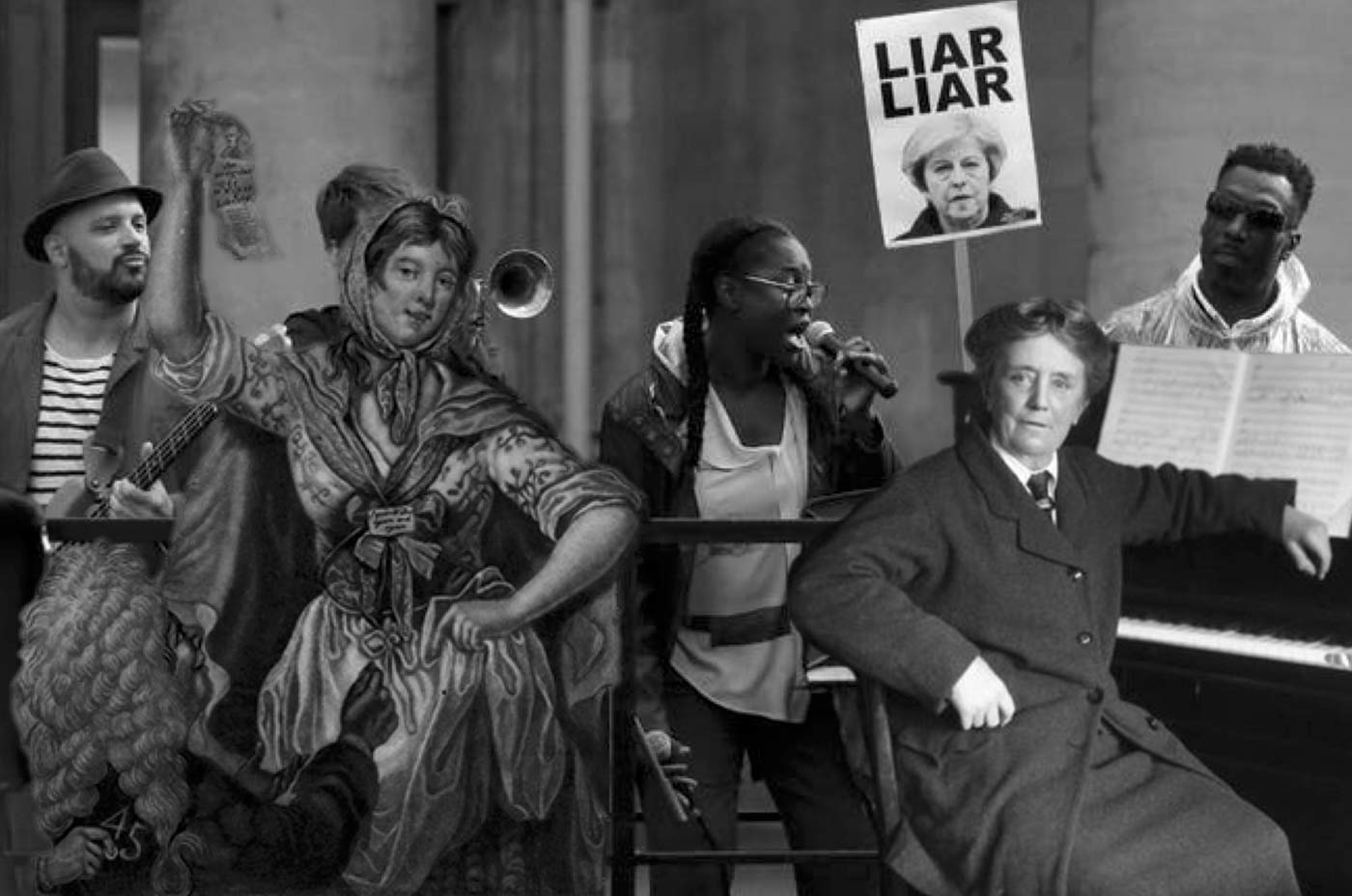
420 years of English protest song: Captain Ska feat. a Georgian ballad-singer, with Ethel Smyth on keys