
- January 5, 2023
- by Uri Agnon
- 5 min. read
Making Choice Matter: Indeterminate Activist Music
Composer Uri Agnon demonstrates how two pieces of highly conceptual music can make a tangible difference to the climate crisis.
The future’s unpredictability is meaningful in both politics and music. The multiplicity of possible outcomes is integral to activism, and music making. The musical approach that is most interested in the impossibility to fully control the future is indeterminacy, where choices that are ‘traditionally’ made by a composer are passed on; to performers, to the audience, or to chance. The score for 1969’s HPSCHD by John Cage and Lejaren Hiller, for example, was created with a computer software that randomly processed pieces by famous composers creating keyboard solos. A group of one to seven harpsichordists play this material, choosing what to play and in what order, alongside tapes that are played on one to fifty-two amplified machines. The audience too has agency and is free to move around in the space. The premiere’s duration was over five hours, but performers can decide on any length.
HPSCHD (first part)
Indeterminacy is often described as political because it explores less hierarchical power dynamics. Cage argued HPSCHD shows that just as the ensemble has no need for a conductor, nor does wider society. Others have criticised such experiments as useless and bourgeois (Cornelius Cardew) or as having no necessary relationship to politics outside of art (Claire Bishop). Rather than contribute to this debate, I would like to explore how indeterminate music can be applied to political activism, using two examples.
BP Fiddles As The World Burns
BP Fiddles As The World Burns is an artistic intervention by artist-activist group BP Or Not BP? (BONB), of which I am a part. BONB is a group dedicated to stopping oil sponsorships in arts and cultural institutions; sponsorships that are used to greenwash the public image of big polluters. In May 2021 BP sponsored an exhibition at the British Museum focused on the Roman emperor Nero. This theme lent itself to a subversive protest-performance in which we staged BP as the emperor who fiddles as Rome burns.

See right for video of this protest
To do this, we needed violins. The museum, though, bars the entrance of musical instruments, and the violins had to be smuggled in. It was impossible to know in advance how many would make it, or if the performance would last 30 seconds or two hours, as that too would depend on security staff. Rather than treat these unpredictable elements as nuisances, we took them as creative material, and composed an indeterminate piece for three violins, an activist choir, and a tape part.
The violin music is formed of three phrases. It opens with everyone playing the first phrase in unison, and ends with a unison of the last phrase. In between, each performer chooses the number of times they loop each phrase, and they can cut them up and repeat smaller sub-phrases. The piece therefore has unpredictable counterpoint, and its length is adjustable in real time. In this way a small number of memorable bars can create a long and detailed piece that would work with one, two, or all three violinists.
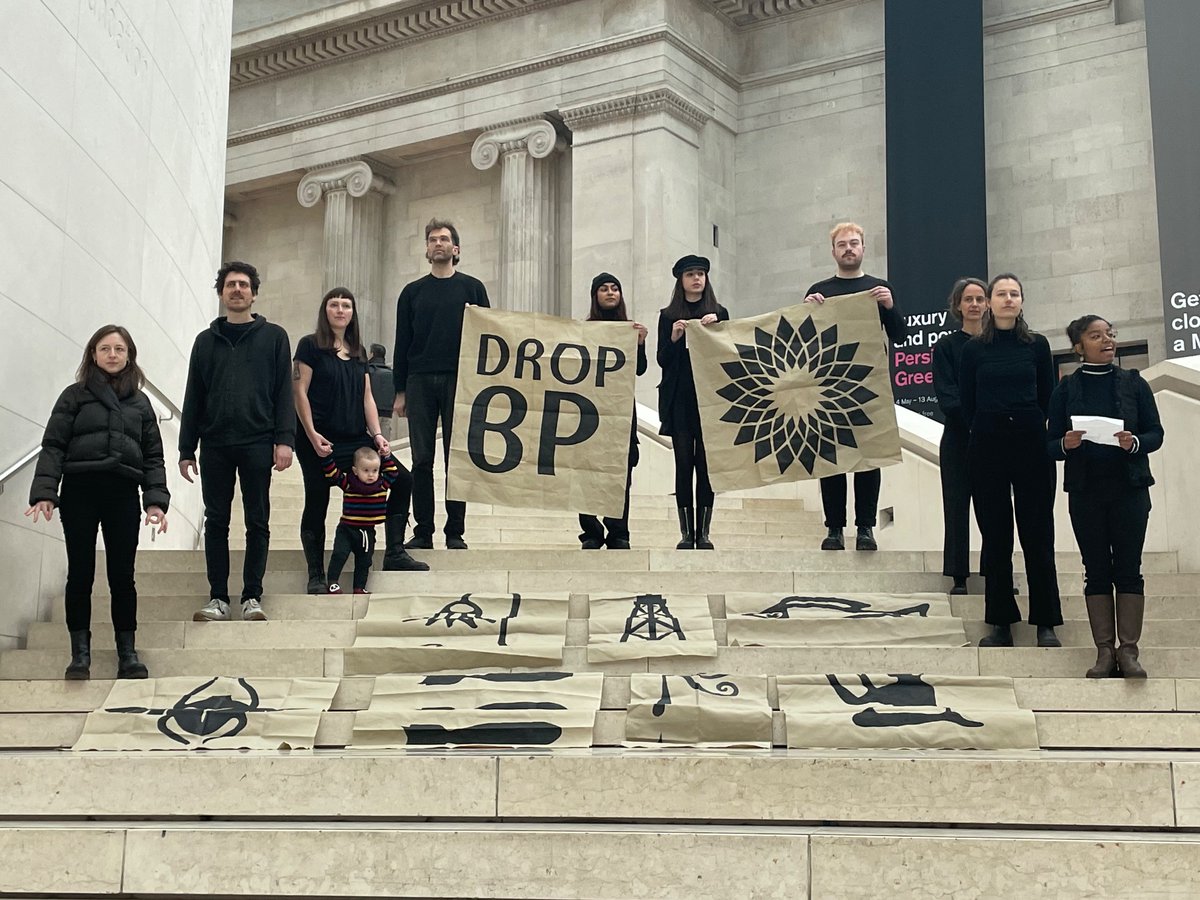
Photography by Ron Fassbender. Uri is second from the left.
A music that feels urgent, almost frantic
Indeterminacy was used as a practical solution, but its function was not only pragmatic. The phrases are careless and dance-like, emphasising the idleness with which BP and the museum are dealing with the climate crisis (and with capitalism and colonialism more generally). The dense overlying of different length ‘careless’ phrases, however, creates a music that feels urgent, almost frantic. A music which is both expressive and practical, combining aesthetic and activist consideration and creating an adjustable, flexible, effective tool for activist performance in uncertain circumstances.
Or Never
A different approach to political indeterminate music is offered in the orchestral piece Or Never, where performers’ choices outside the concert hall, personal and political, shape the music.
Before playing the piece the performers answer a list of questions that have to do with their reaction to the climate crisis. Questions relate to their opinions (e.g. ‘is it moral to eat an avocado?’), their everyday choices (e.g. ‘have you ever recycled a can of tomatoes?’), and their political actions (e.g. ‘have you ever participated in a protest?’ and ‘have you ever tied yourself to an oil rig?’).
Every question appears above a musical section, and each performer must only play that section if they’ve answered ‘yes’ to the relevant question. In performance the questions are projected behind the ensemble, allowing the audience to follow the sudden and drastic changes in instrumentation (from the relative quiet of ‘have you protested?’ to the tutti of ‘should we protest?’), and to reflect on the same issues themselves.
The piece will sound different with every ensemble that plays it. In fact, owing to questions such as ‘have you had a meaningful conversation about the climate this week?’, the piece changes between one rehearsal and the next and between different performances by the same orchestra.
While interviewing members of Southampton University Symphony Orchestra, who commissioned and premiered this piece, I was told that Or Never inspired them to rethink their answers, sparked conversations and prompted them to act differently. Being of a generation that is, generally speaking, very concerned with the climate crisis, the work seemed to resonate with many of the players.
The viola section were considering tying themselves to an oil rig so that they could finally have a viola solo.
One performer remarked that she sees herself as a climate activist, and so made sure to be able to answer ‘yes’ to ‘have you had a meaningful conversation about the climate every week?’, and to perform the relevant section. During one of the rehearsals I learned that the viola section were considering tying themselves to an oil rig so that they could finally have a viola solo.
While this sadly never materialised it highlights the fact that performers’ agency is at the very heart of the piece. But instead of this agency being purely aesthetic, as it often is in indeterminate pieces, it reaches outside of the rehearsal space. At the first rehearsal we had on Or Never the section below ‘Have you ever participated in a protest’ sounded like a snare and piccolo duet. By the day of the première a large portion of the ensemble were playing it.
I’m not claiming anyone did anything only so that they could play more music. But agency is a sticky thing, and our performances, as musicians, as activists, and as humans, are all connected. The limited consequences of the players’ musical agency in Or Never resonate with the restricted yet meaningful agency we have over the politics that rule our lives. Choice and consequence are especially complex in the climate context, where we are constantly told to make unending, impossible consumer choices that have very little effect. We feel guilty and helpless at the same time. Tying our agency to that of others, taking individual and group decisions on the mundane and the dramatic, seizing agency in everyday life, as well as in activist interventions, is what this piece offers as a way forward.